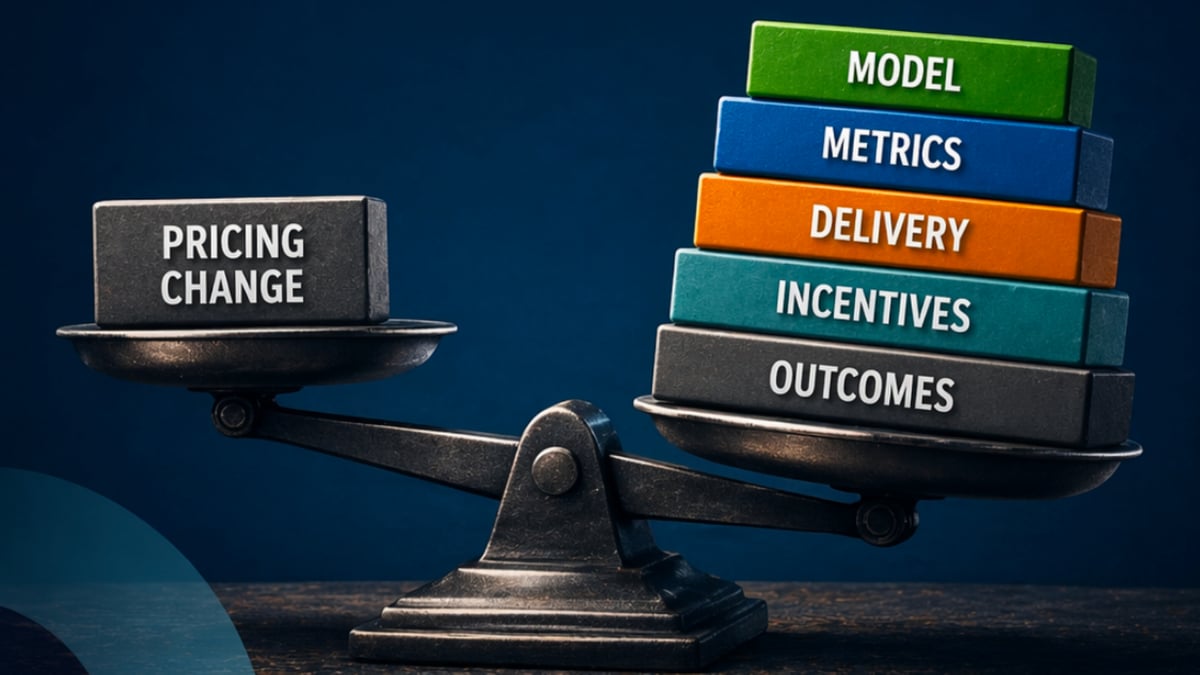
Outcome-Based Pricing Is More Than a Pricing Change
There is a growing assumption in enterprise software that AI will change the value equation, and pricing will follow. I would be careful with that assumption.
In my conversations with leaders across customer, product, and technology functions, this is where the discussion gets more complex. Outcome-based pricing is not just a pricing change. It is a product change, a measurement change, a delivery change, and an operating model change.
That is why the move is difficult. Seat-based pricing is relatively simple. Consumption pricing is more dynamic, but still straightforward. You charge for access, usage, or scale. Outcome-based pricing sets a higher bar.
Why the Shift Is Harder Than It Looks
A company has to define the outcome clearly, establish a credible baseline, measure improvement in a way the customer accepts, and show that its product contributed materially to the result. That is hard in real operating environments.
Attribution is rarely clean. Results are shaped by multiple systems, teams, decisions, and external factors. The larger issue is the operating model behind the promise.
- Someone has to own the measurement.
- Someone has to own adoption.
- Someone has to stay close enough to the customer workflow to verify the promised outcome is being achieved.
Many SaaS companies are now trying to absorb AI while also rethinking pricing and redesigning the operating model behind it.
We have seen a version of this before. The move from perpetual licensing to subscription took years. Some companies made the shift well. Many did it partially. Some never finished. That should inform expectations now.
The Operating Model Behind the Promise
If a company wants to charge for outcomes, it has to rethink how value is delivered and owned after the sale. Deployment, customer success, services, support, product feedback loops, and accountability for value realization all matter differently.
The industry is asking companies to do even more at once: incorporate AI, rethink product architecture, adjust delivery, retrain teams, revisit pricing, and sometimes redesign post-sale ownership of outcomes.
Some will not have the telemetry. Some will not control enough of the customer workflow to stand behind the outcome. Some will find that customers prefer the idea of outcome-based pricing to actually signing that contract, and that their own post-sale organisation was never built to own what the contract promises.
Why Hybrid Models Will Likely Prevail
I expect hybrid models to be the norm: subscription where the relationship is established, consumption where usage is clear, and outcome-linked pricing in selective cases where the use case is specific, the data is strong, and the post-sale operating model is mature enough to support it.
That is the more realistic path. Not every company will be ready to price on outcomes across its portfolio, and not every customer will want to buy that way.
CLOSING PERSPECTIVE
Changing the Price Is Easier Than Changing the Model
Changing pricing is one thing. Changing what you have to deliver to justify it is something else entirely.
Outcome-based pricing should be understood as an operating model decision. It changes what the company must measure, how it must deliver value, and what it must prove over time.
ABOUT SUCCESSLAB
About SuccessLab
SuccessLab is an executive community and advisory firm at the intersection of AI, customer leadership, and enterprise service strategy. Founded by Omid Razavi, SuccessLab organises peer forums, roundtables, and the CCO Perspectives series for senior executives navigating enterprise transformation.
Omid Razavi, Ph.D. Founder, SuccessLab April 2026
Download
More perspectives on AI, customer value, and customer leadership at SuccessLab . Join the SuccessLab community .