

Customer Service & Support
July 24, 2026
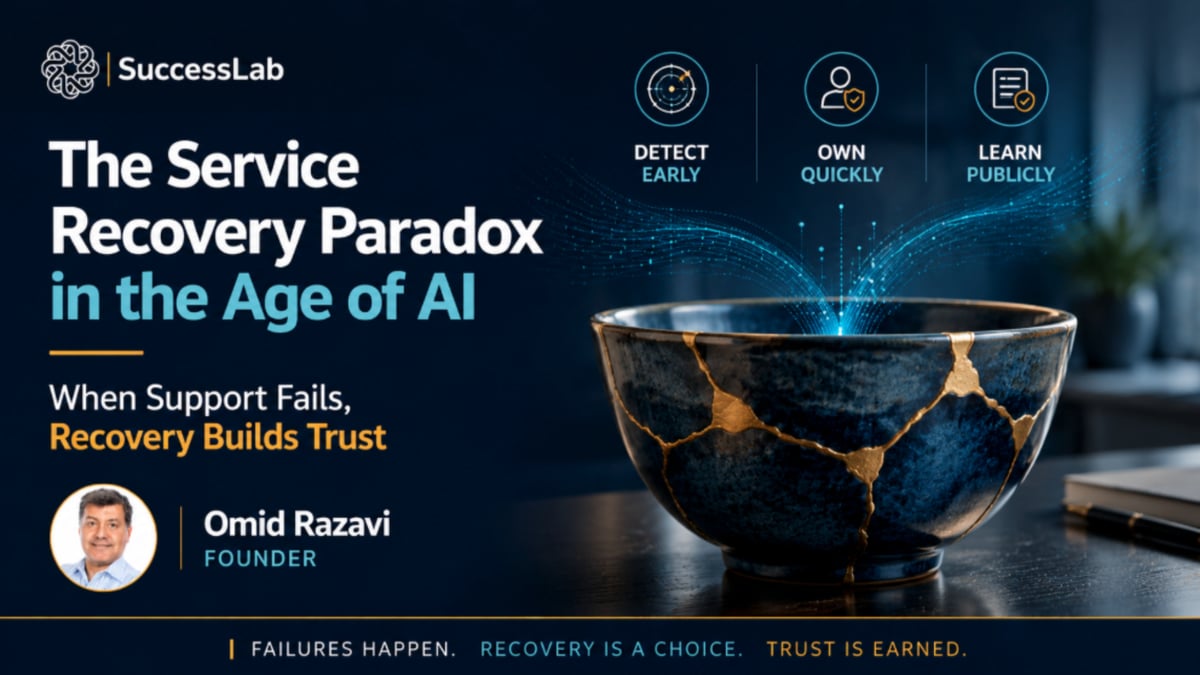
The Service Recovery Paradox in the Age of AI
# Service Recovery
# Customer Trust
# Human-AI Collaboration
When Support Fails, Recovery Builds Trust

Omid Razavi
Opening
A flight from New York to Cancun left six hours late, made two unexpected stops, ran out of food, and landed hard. By arrival, the passengers had written off their Club Med vacation.
Then they walked into the terminal.
The resort manager was waiting with food and music. He welcomed them and drove them to the resort himself.
Those guests ended up rating the trip higher than if the flight had gone smoothly.
Christopher Hart, James Heskett, and Earl Sasser shared this story in their 1990 Harvard Business Review article, "The Profitable Art of Service Recovery." Michael McCollough and Sundar Bharadwaj later gave the phenomenon a name: the Service Recovery Paradox.
A well-managed failure can create more trust than a flawless experience.
Service Recovery Paradox: Successful recovery can restore customer confidence beyond its prior level.
The evidence behind this paradox is mixed, and the conditions are narrow. Severe, repeated, security-related, or compliance-sensitive failures may permanently erode trust. A standard apology, credit, or status update may calm the customer, but it rarely strengthens the relationship.
In enterprise SaaS, recovery is also more complex than a hospitality interaction. The customer is rarely one person. Support must restore operational confidence across technical users, business owners, executives, security teams, and sometimes regulators.
Meaningful recovery requires three things:
- Clear ownership. The customer sees someone accountable for the outcome.
- Visible commitment. The response exceeds the normal incident playbook.
- Demonstrated learning. The customer sees what changed because of the failure.
Most organizations stop before the third. They resolve the issue, close the case, and move on. The customer never sees the safeguard, product change, or operating improvement that followed.
AI makes that gap more consequential. It can detect risk earlier and coordinate recovery at scale. It can also make mistakes across more interactions, with less human judgment in the moment.
The real test begins after something goes wrong.
Act Before the Customer Escalates
Every support leader knows the warning signs. A case stays open too long. Commitments are missed. Cases reopen. Contacts repeat. Replies become shorter and more formal. Senior stakeholders join the thread. Requests shift from technical answers to ownership and accountability.
The escalation comes later.
At SupportLogic, I worked with support leaders using sentiment and escalation signals across customer conversations. The data reinforced what experienced operators already knew: customers reveal declining confidence well before they formally escalate.
An escalation is an opportunity you do not get to waste.
The best opportunity often comes earlier. A senior leader who calls before being asked and says, "We know this has gone on too long. Here is what we are doing, and here is who owns it," is taking initiative. The same call after an executive complaint feels required.
AI can monitor sentiment, case age, missed commitments, reopened cases, repeated contacts, response patterns, and stakeholder changes across every interaction. These are probabilistic risk signals, not conclusions. A terse reply may reflect urgency, culture, or communication style rather than declining trust, so people must validate the context before acting.
Recover from the signal, not the escalation.
Make the Commitment Visible
Resolving the issue restores service. Rebuilding confidence requires more.
Enterprise customers know the standard response to a serious SaaS incident: a severity-one case, an incident bridge, frequent updates, a workaround, and eventually a root cause analysis. Those steps are expected.
Recovery lands when the company visibly commits more:
- A temporary environment or additional capacity at no charge.
- A senior support, engineering, or product leader joining the customer's operating cadence.
- A rapid root cause analysis with clear ownership and corrective actions.
- A later review showing what changed in the product, monitoring, or deployment process.
Customers can see the access, judgment, and effort being committed. The response should be proportionate to the impact. Visible commitment may include senior involvement or temporary capacity, but it can also mean a credible owner, an honest update cadence, faster access to expertise, and less work for the customer. Those signals carry more weight than a polished apology.
This should be designed into the operating model. Leaders need predefined recovery options, clear decision rights, and authority close to the customer. The goal is disciplined discretion, not expensive heroics.
AI can detect risk, assemble context, recommend actions, and coordinate the workflow. The organization still decides when human ownership is required, what commitments can be made, and who can make them.
Trust Is Built After the Fix
I have seen critical issues resolved within hours while the relationship remained cold. I have also seen difficult problems take weeks and end with a stronger customer advocate.
The difference often appears after the technical work is complete.
A strong follow-up shows the customer what changed:
- The regression test protecting the affected code path.
- The alert that would have detected the issue earlier.
- The runbook or escalation path that was updated.
- The product fix that shipped.
- The process change introduced across support, engineering, or customer success.
This changes the customer's role. They become a contributor to a better product rather than simply the recipient of a failure.
Very few SaaS companies return weeks later with a specific update on what changed. That follow-up often builds more trust than another executive check-in.
AI can make this discipline repeatable. The recovery workflow should remain open until the learning is documented, the corrective action is complete, and the customer has seen the result.
AI Must Know When Trust Requires a Human
AI handles many parts of recovery well. It can respond immediately, assemble context, summarize history, identify patterns, recommend next steps, and keep the customer informed. Its actions still require controls: approved data access, confidence thresholds, evidence behind risk scores, auditable decisions, clear limits on autonomous commitments, and regular review of missed and false alerts.
For common issues with clear resolution paths, that can be faster and more consistent than waiting for a person.
Human ownership becomes essential when:
- The company caused the failure.
- An earlier automated response was wrong.
- Customer confidence is deteriorating.
- Judgment, discretion, or executive accountability is required.
- The customer is asking for ownership rather than information, or the issue carries material business, security, regulatory, financial, or safety consequences.
Most routing logic asks whether AI can answer the technical question. Support leaders must also assess customer confidence, vendor responsibility, and business, security, or regulatory consequences. A calm customer may still face material risk that requires immediate human ownership.
AI should recognize when that threshold has been crossed and bring in the right people with the history, evidence, actions taken, uncertainty, and recommended next step already assembled. Roles must be explicit: an incident commander directs technical response, a support or customer success leader owns communication, an executive sponsor carries accountability, and the account team handles commercial remediation when needed.
A more human-sounding response will not restore trust when the customer needs someone to say, "We own this."
Operationalize the Recovery Lifecycle
Early detection and recovery are related stages of the same lifecycle, with different owners and different measures. Enterprise support leaders should design four connected motions:
- Prevention. Detect risk before customer confidence materially breaks.
- Containment. Limit operational impact, customer effort, and relationship damage.
- Recovery. Restore service, confidence, and clear ownership.
- Learning. Prevent recurrence and show the customer what changed.
AI can support all four motions, but each needs different triggers, owners, permissions, and success measures.
Measure Whether Recovery Worked
Recovery should be managed with more than case closure and time to resolution. A practical scorecard includes time from first risk signal to intervention, time to named ownership, commitments met, reopen and repeat-incident rates, corrective actions completed, and the percentage of customers who receive a closed-loop follow-up.
AI-specific measures should include predicted escalations caught before formal escalation, false-positive and missed-alert rates, handoff quality, and the accuracy of summaries and recommended actions. Customer confidence, retention, and expansion outcomes should be reviewed after serious incidents to test whether the recovery restored the relationship.
Three Design Priorities
- Detect declining confidence early. Monitor sentiment, case age, customer effort, repeated contacts, stakeholder changes, and response patterns. Act before the customer has to escalate.
- Build human ownership into the workflow. Define when AI continues, when it recommends intervention, and when it transfers control. Route based on trust, responsibility, and business impact alongside technical complexity.
- Close the learning loop with the customer. Track significant recoveries through corrective action and follow-up. Show the customer what changed because of their experience.
Recovery Is a Leadership Test
The Service Recovery Paradox describes a moment when customers assess the competence and character of the company they chose.
They notice who shows up, how quickly the organization takes ownership, what resources it commits, and whether anything changes afterward.
AI is creating more of these moments. Automated support expands interaction capacity and increases the number of decisions made without human judgment.
The leadership challenge is to design a system that detects risk early, mobilizes the right response, and recognizes when trust requires a person to take ownership.
The Club Med manager did not wait for an escalation. He understood that the experience had gone badly, had the authority to act, and arrived before anyone asked.
That remains the standard. AI should help support organizations see the moment earlier, respond more consistently, and make the learning visible long after the issue is resolved.
About
Omid Razavi, Ph.D., is the founder of SuccessLab, an advisory and executive community focused on the intersection of AI transformation and enterprise customer leadership. He publishes CCO Perspectives, convenes the SuccessLab Executive Forums and Roundtables, and advises customer, revenue, services, and support leaders across the enterprise technology industry.
Join us at community.successlab.us to continue the conversation.
Download
More perspectives on AI, customer value, and customer leadership at SuccessLab . Join the SuccessLab community .
1
Comments (0)
Popular

Dive in
Related
Blog
AI and the Art of Omotenashi: Reshaping Customer Service
By Omid Razavi • Jun 25th, 2023 • Views 4
Blog
Lisbon: A Community Ready for the Future of AI-Powered Service
By Omid Razavi • Nov 28th, 2025 • Views 22
Blog
AI and the Art of Omotenashi: Reshaping Customer Service
By Omid Razavi • Jun 25th, 2023 • Views 4
Blog
Lisbon: A Community Ready for the Future of AI-Powered Service
By Omid Razavi • Nov 28th, 2025 • Views 22