

Customer Success & Growth
August 23, 2026
Show the Work: What SaaS and AI Product Demos Must Prove

# SaaS
# Customer Value
# Agentic AI
Demonstrate the business change, the exception path, and the value beyond adoption costs.

Omid Razavi
I do not need another product tour. I need a reason to add more software.
I receive a steady stream of SaaS introductions and demos.
Founders want my perspective on products they are building for customer service, support, and success.
Sellers want to show me their products and convince me to buy them for SuccessLab.
I appreciate the outreach. I know how hard it is to build a product, create a category, and earn a buyer’s attention.
But I am questioning the traditional product introduction and demo.
SuccessLab subscribes to more than a dozen SaaS products, including Claude and ChatGPT. Each was added for a reason. Solve a problem. Support a process. Run part of the business. Build something faster.
Over time, the software adds up.
- More accounts.
- More data in separate places.
- More workflows to maintain.
- More interfaces to learn.
- More subscriptions to justify at renewal.
And I am beginning to unlearn SaaS UI/UX.
I have less interest in learning another navigation structure, remembering where features sit, or figuring out how another application wants me to work.
And I am not sure I need another AI assistant bolted onto every SaaS product either.
If my agent can already access the system, work with the data, and get the job done, what does another embedded AI assistant add?
With agentic tools, I can increasingly ask for the work I need done.
- Pull information from different sources.
- Analyze it.
- Create a report.
- Draft content.
- Organize work.
- Prepare actions.
- Schedule follow-up.
Much of this can happen across the systems, data, and content I already have.
That changes what I need from a demo.
A polished tour of screens, features, configuration, and reporting may show that the product works.
It does not prove why I should add another system to my tech stack.
The burden of proof for adding software is getting higher.
The question I want answered is:
What can I accomplish with this product that I cannot with the systems and agents I already have?
That is the product introduction and demo I want to see.
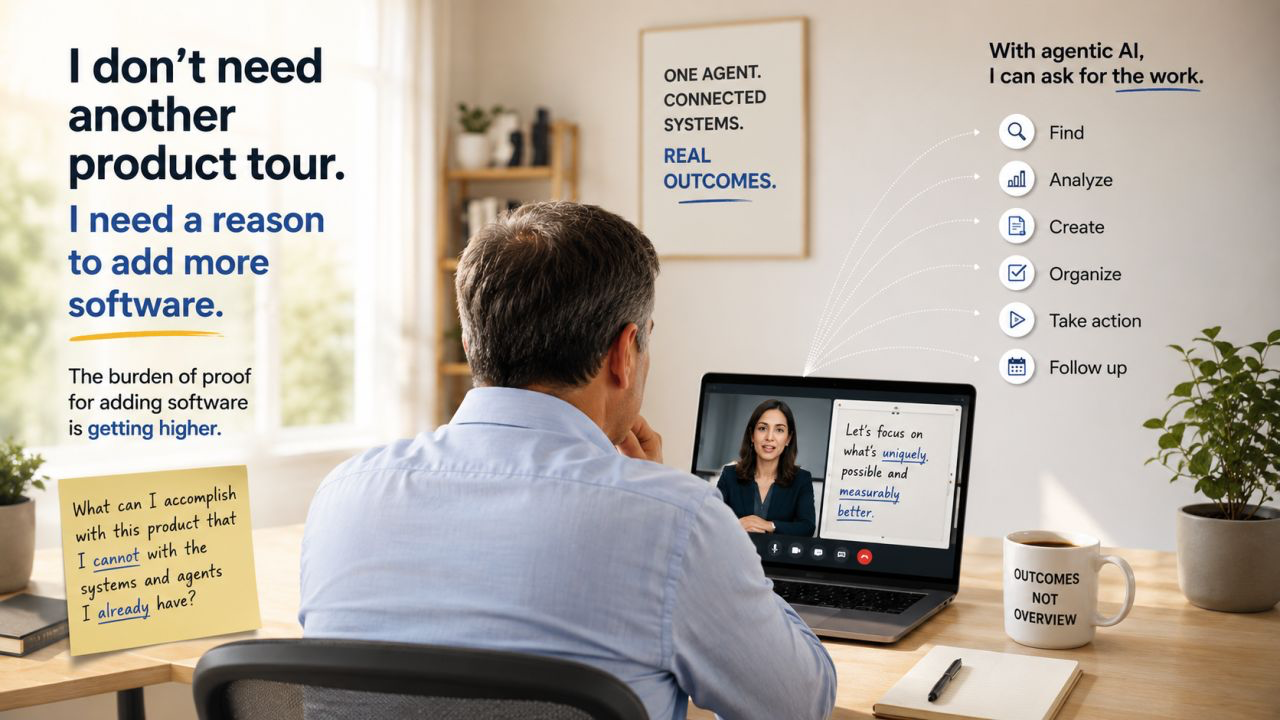
The case for adding software. Original illustration from the LinkedIn series.
What should a SaaS demo prove now?
What a credible demo must prove
Do not demo your product. Demo the work it can eliminate, improve, or make possible.
In my previous post, I asked:
What can I accomplish with this product that I cannot with the systems and agents I already have?
A good demo should give me credible evidence.
The traditional demo begins with the product:
- Here is the dashboard.
- Here is the workflow.
- Here is how to configure it.
- Here is our AI assistant.
- Here is the reporting.
A better demo begins with the work.
Show me a real business problem before your product touches it.
Show me how it gets done today, the systems it crosses, where it breaks down, and what it costs in time and effort.
Then show me what changes:
- What work disappears, improves, or becomes possible?
- Which decisions become faster or better?
- What measurable outcome improves?
Adding another application carries costs beyond the subscription. Integration, migration, security, training, process change, and ongoing administration all add up.
That is the adoption tax.
The value created must be substantially greater than that tax.
The demo should also survive contact with reality.
Show me what happens when the information is incomplete, systems disagree, the agent lacks confidence, a policy restricts the action, or human judgment is required.
The happy path demonstrates capability.
The exception path tells me whether I can trust the product.
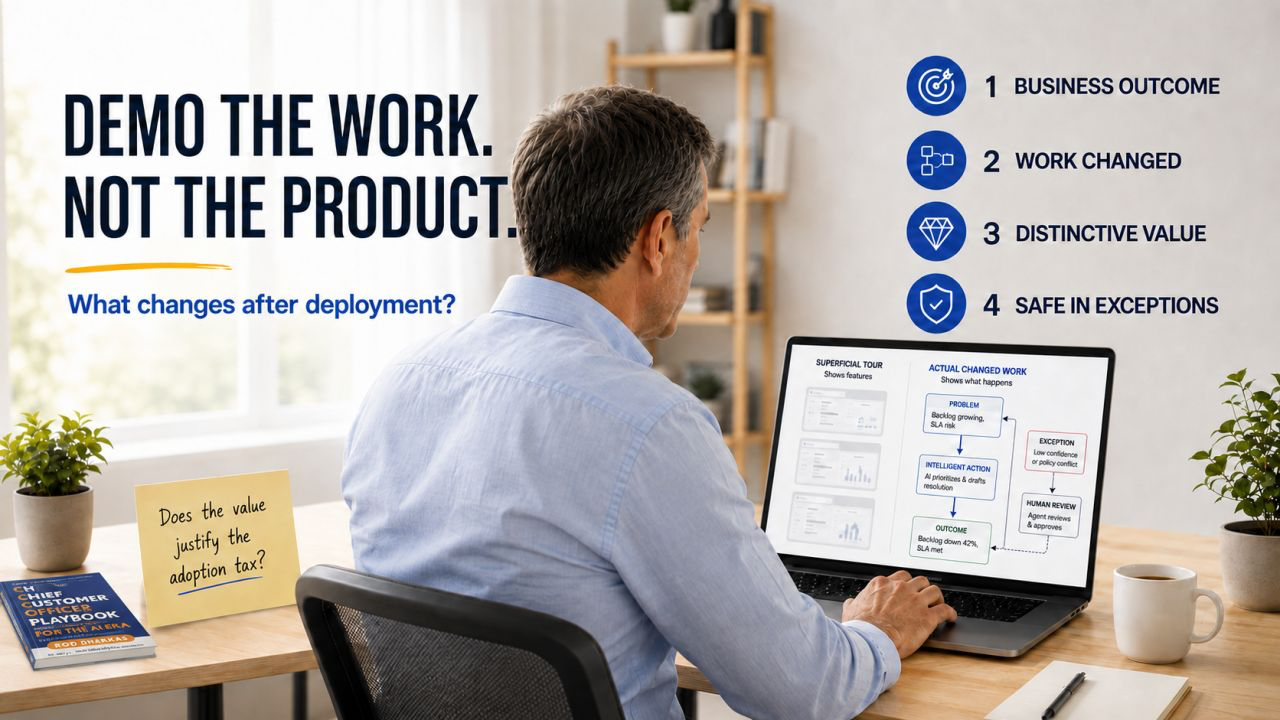
Demonstrate the work that changes. Original illustration from the LinkedIn series.
If I had 30 minutes to evaluate a new SaaS or AI product, I would want the demo to answer four questions:
- What business outcome will improve, and how will we measure it?
- What work will change or disappear, and why can’t my current systems and agents do it?
- What distinctive context, intelligence, or capability does the product add?
- What happens when the data is incomplete, confidence is low, or something goes wrong?
By the end of the demo, I should understand what will be different after deployment, how quickly we can produce evidence of value, and whether that value justifies the adoption tax.
A software tour shows me what the product can do.
A strong demo shows me what will change in the business, what evidence we should expect, and whether the value justifies adding another system.
If you had 30 minutes to evaluate a new SaaS or AI product, what would you ask it to prove?
Original publications
Comments (0)
Popular

Dive in
Related
Blog
Decoding Automation in SaaS: Rule-Based, Logic-Based, and AI-Based Systems Explained
Dec 19th, 2024 • Views 4
Blog
Knowledge Graphs Matter for AI in Customer Service—And What Else You Need
Feb 18th, 2025 • Views 10
Blog
Decoding Automation in SaaS: Rule-Based, Logic-Based, and AI-Based Systems Explained
Dec 19th, 2024 • Views 4
Blog
Knowledge Graphs Matter for AI in Customer Service—And What Else You Need
Feb 18th, 2025 • Views 10