

Customer Leadership & Strategy
November 6, 2026
Before “Make It So”: Leadership, Dissent, and Judgment in the AI Era

# Executive Leadership
# Human-AI Collaboration
# Enterprise AI
What the bridge of the Enterprise reveals about whose thinking shapes a decision.

Omid Razavi
Sir Patrick Stewart’s portrayal of Captain Jean-Luc Picard on the bridge of the Enterprise in Star Trek: The Next Generation, my favorite science fiction series, offers a lasting picture of thoughtful leadership.
I remember how Picard listened. He would rest a hand against his chin and turn toward a junior officer. For a moment, you watched that officer as closely as you watched the captain. Stewart made you want to hear what they had to say.
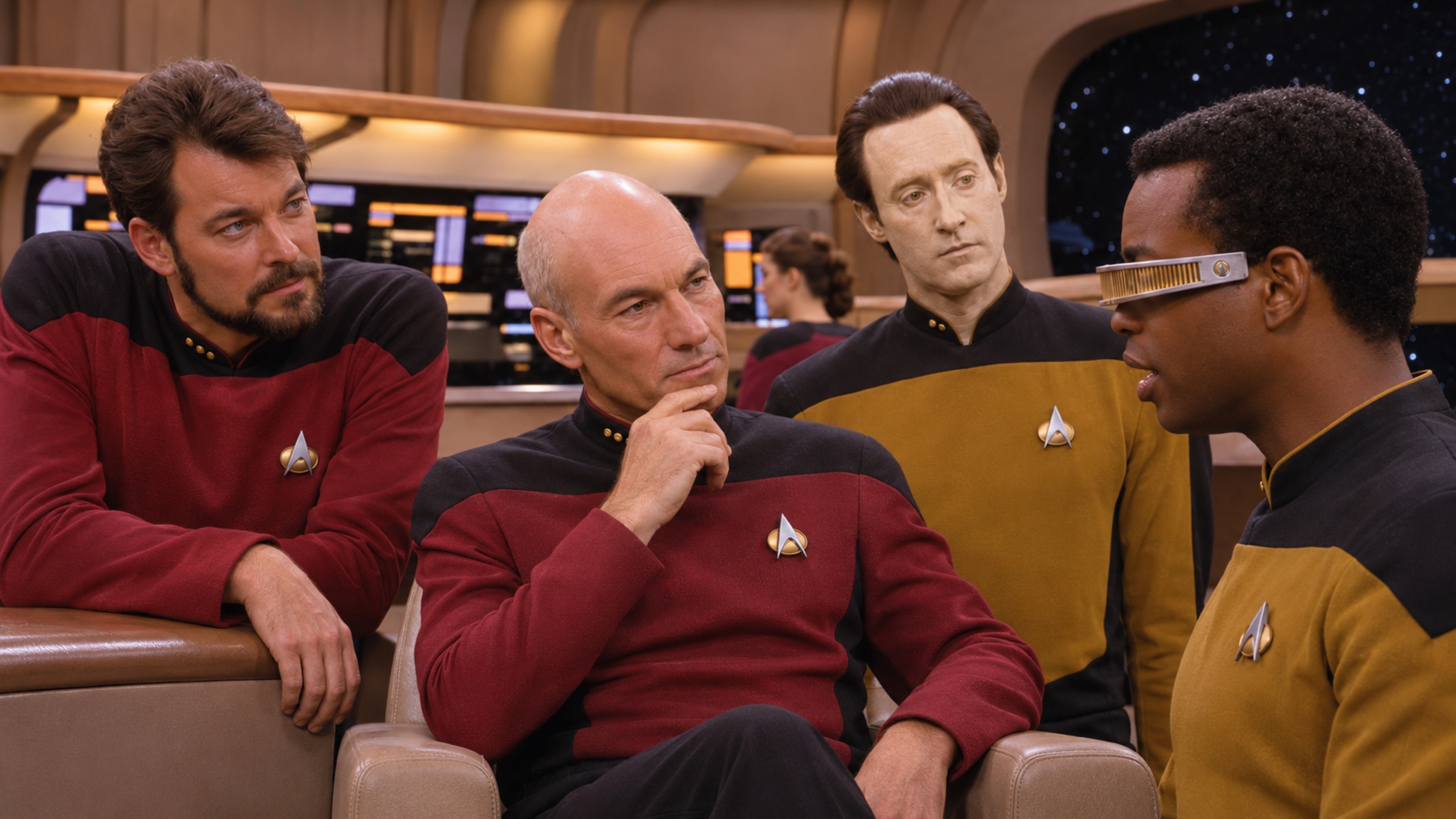
On the Enterprise bridge, different perspectives help shape the captain’s decision. AI-enhanced adaptation of supplied Star Trek imagery.
Who had the captain’s ear?
Picard could summon the ship’s computer with a word. It could search the ship’s records while his officers were still forming their questions. Yet when Picard turned to Data, an android and a fellow officer, what interested him was Data’s judgment. And Riker understood that being first officer sometimes meant questioning an order in front of the people who would have to carry it out.
I liked that you could usually tell whose thinking had shaped a decision. Geordi saw an engineering possibility. Troi heard something in a voice that the others had missed. When Picard finally said, “Make it so,” everyone knew who would answer for the decision, and whose idea had made it possible.
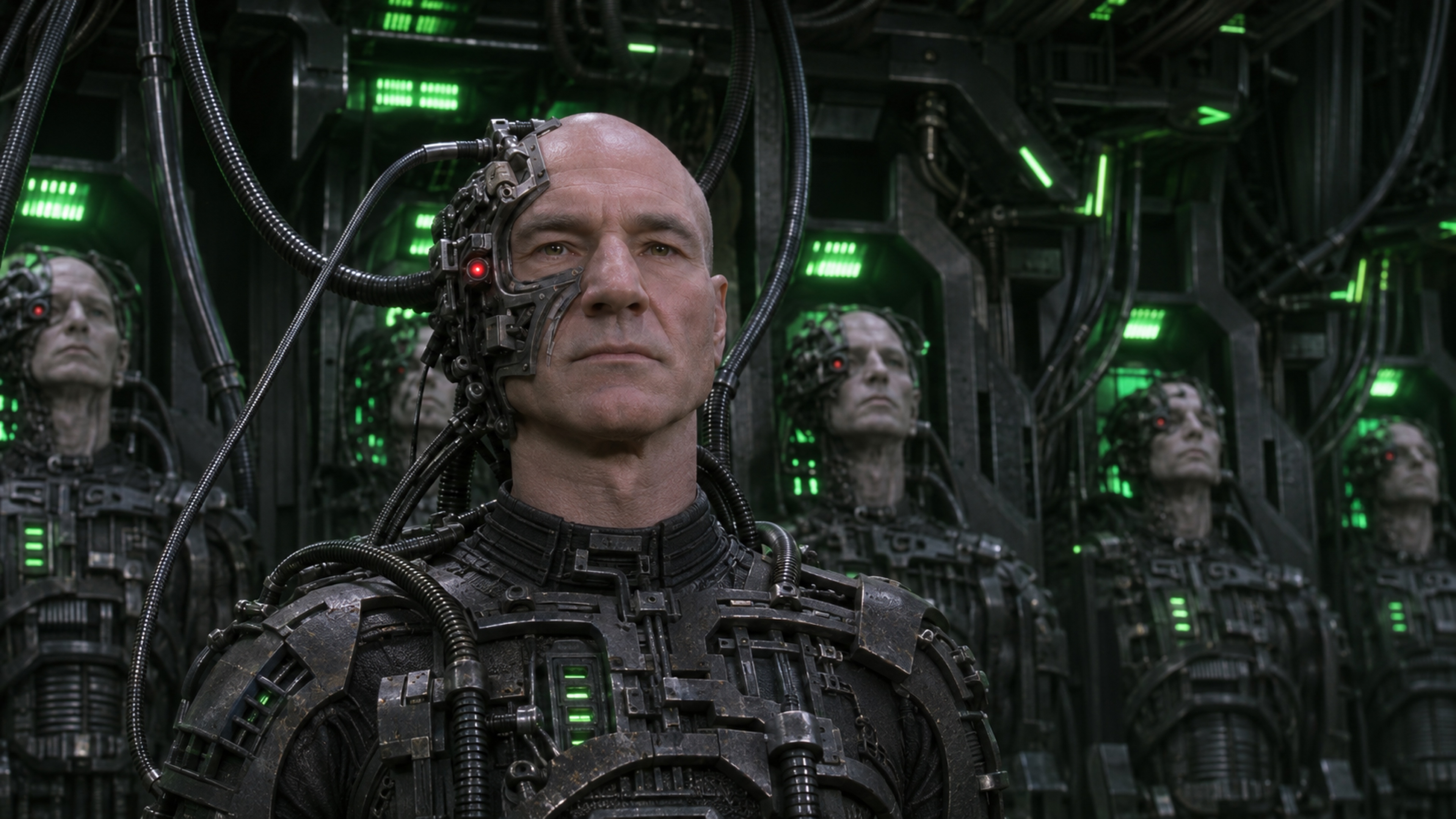
Locutus: Picard’s voice and authority, without the freedom to choose. AI-enhanced adaptation of supplied Star Trek imagery.
What the Borg took from Picard
Then Stewart gave us Locutus. The Borg absorbed the knowledge and abilities of everyone they assimilated, linking their minds and directing them toward a single purpose. They could draw on Picard’s understanding of Starfleet and use his voice to address his own crew. Stewart made that familiar voice unsettling. It carried all the authority of the captain we knew, speaking words he had no freedom to choose.
There’s something moving about who came to his rescue. For years, Picard had expected his officers to exercise their own judgment, even when it led them to challenge his. When he could no longer guide them, that habit held.
Who gets to question the mission?
I think of the bridge and the Borg cube as two contrasting styles of leadership. Picard asked his officers to help him decide what ought to be done. The Borg valued each mind for what it could contribute to a purpose already settled. Both could put everyone’s knowledge to work. Only on the bridge could someone question the purpose itself.
An AI system trained on years of project proposals and approval decisions can learn which ideas our leaders tend to support. Use it to rank new proposals, and people may start shaping their ideas around what it favors. The ideas that disappear may leave no record. They’ll be the ones people decide are no longer worth bringing forward.
When AI speaks for the organization, how will the person who sees things differently know that we still want to hear from them?
Original publication
Comments (0)
Popular

Dive in
Related
Blog
Rethinking Revenue and Customer Leadership in the Agentic Era
By Omid Razavi • Jun 7th, 2026 • Views 47
Blog
People First, Outcomes Always: Bryan Belmont’s Blueprint for Leadership in the AI Era
May 8th, 2025 • Views 6
Resource
Support to Customer Leadership: The New Mandate for the AI Era
By Omid Razavi • Sep 6th, 2026 • Views 44
Blog
Rethinking Revenue and Customer Leadership in the Agentic Era
By Omid Razavi • Jun 7th, 2026 • Views 47
Blog
People First, Outcomes Always: Bryan Belmont’s Blueprint for Leadership in the AI Era
May 8th, 2025 • Views 6
Resource
Support to Customer Leadership: The New Mandate for the AI Era
By Omid Razavi • Sep 6th, 2026 • Views 44