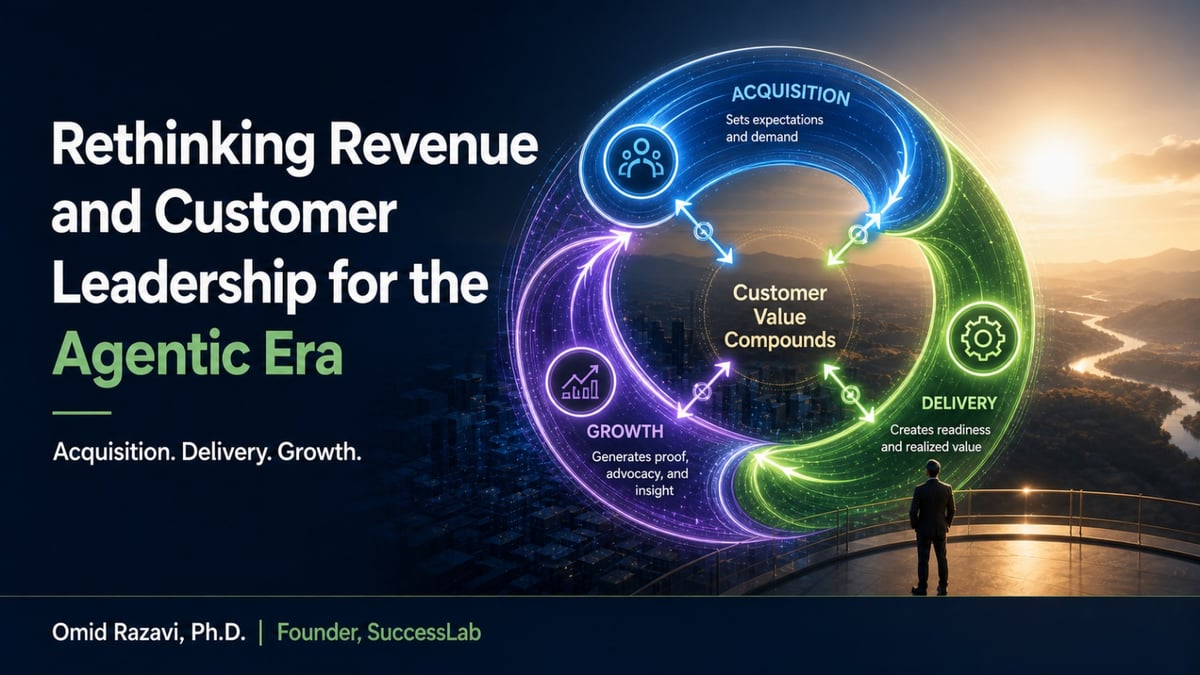

Most enterprise software companies say they are organized for retention and growth.
Their org charts, investments, incentives, and executive attention suggest otherwise.
The revenue that increasingly determines enterprise value is created after the sale. Yet many companies still direct disproportionate executive attention, investment, and talent toward acquisition.
The problem is rarely execution alone.
It is structure.
The metrics make it visible:
▪️𝗚𝗥𝗥 measures the durability of the installed base.
▪️𝗡𝗥𝗥 measures its growth.
▪️Strong 𝗡𝗥𝗥 on weak 𝗚𝗥𝗥 is expansion masking churn.
Investors know the difference. Increasingly, sophisticated buyers do too.
AI raises the stakes. As agents become users and pricing shifts toward consumption and outcomes, retention is no longer a renewal event.
It is a continuous verdict on value delivered.
The framework I propose rests on a core premise: different revenue motions require different leadership contexts.
▪️𝗔𝗰𝗾𝘂𝗶𝘀𝗶𝘁𝗶𝗼𝗻 brings the right customers in.
▪️𝗗𝗲𝗹𝗶𝘃𝗲𝗿𝘆 turns commitments into customer outcomes.
▪️𝗚𝗿𝗼𝘄𝘁𝗵 protects and expands the installed base.
Two capabilities are often misplaced:
▪️𝗔𝗱𝗼𝗽𝘁𝗶𝗼𝗻 must be owned with Product. Low adoption is a product signal before it becomes a relationship problem.
▪️𝗦𝘂𝗽𝗽𝗼𝗿𝘁 belongs close to Engineering. At scale, tickets are among the clearest product quality signals.
This also changes executive accountability:
▪️The 𝗖𝗥𝗢 is accountable for the revenue system, not just the acquisition engine.
▪️The 𝗖𝗖𝗢 leads the customer organization that turns acquired revenue into durable, expanding revenue.
The “one throat to choke” model failed because it concentrated accountability without distributing capability. Acquisition usually won.
The 𝗖𝗘𝗢 question is unavoidable:
If enterprise value is increasingly created after the sale, have we given the leaders responsible for post-sale outcomes the authority, structure, and resources to succeed?
Where does this match your experience, and where would you challenge it?