

Customer Leadership (CL) Strategies
June 7, 2026
Aligning Revenue and Customer Leadership for the Agentic Era
# CCO
# CRO
Why Acquisition, Delivery, and Growth require distinct leadership contexts

Omid Razavi
Rethinking Revenue and Customer Leadership for the Agentic Era
The debates that consume the most energy in enterprise software are rarely about strategy. They are about structure: how revenue, customer, and product leadership should be organized to create and compound customer value.
Most enterprise software companies say they are organized to retain and grow customers. Their reporting structures, investments, incentives, and executive attention often tell a different story.
The revenue that increasingly determines enterprise value is created after the sale. Yet many companies still direct disproportionate attention, funding, and talent toward acquisition.
That is the structural problem.
In conversations with revenue, customer, and product leaders across enterprise SaaS companies, the pattern is consistent. Companies keep trying to solve fundamentally different revenue motions with a single leadership structure.
The org chart changes. The titles change. The pressure to consolidate revenue functions under one leader never goes away. The tension persists because the structure still forces different problems into the same model.
What follows is both observed pattern and prescriptive argument. It is a deliberate point of view, and the pushback is welcome.
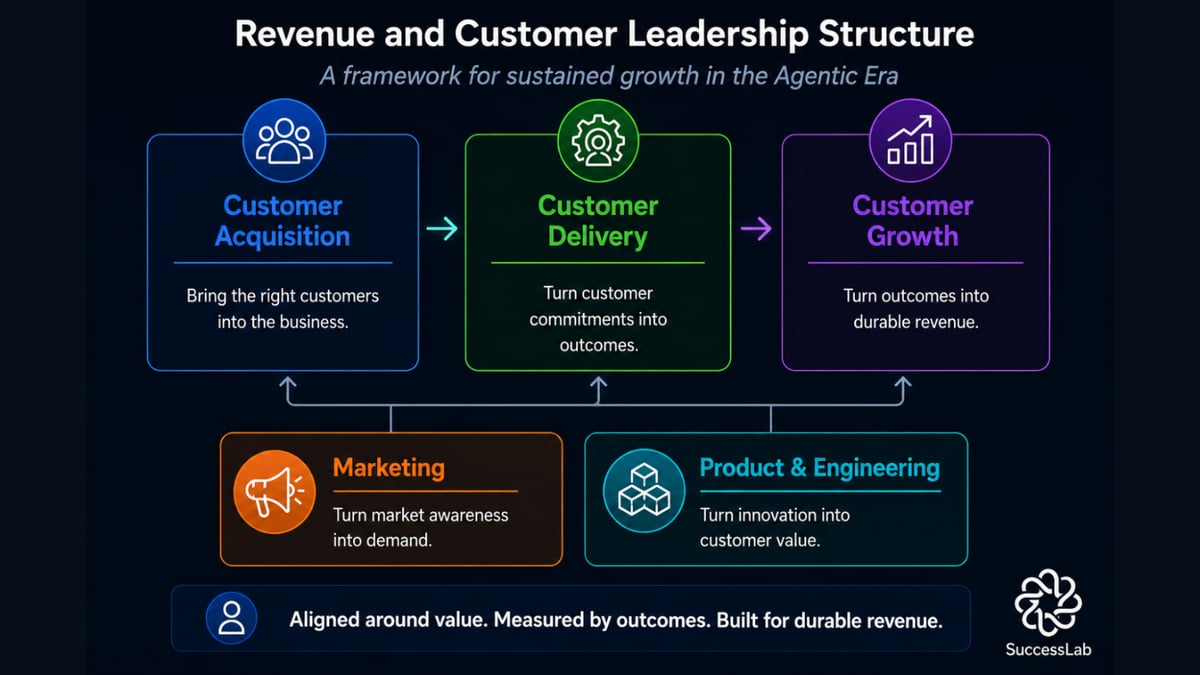
The premise is straightforward. Acquisition, Delivery, and Growth are distinct revenue motions. They require different skills, incentives, operating rhythms, and leadership contexts. When aligned correctly, they reinforce each other. When misaligned, coordination becomes the job. The customer experiences the consequences before the business does.
The metrics make the shift visible. For much of the past decade, enterprise software rewarded new-logo growth, and organizational structures followed. That era has changed. As acquisition costs rise and markets mature, buyers and investors are paying closer attention to the quality of the installed base and the economics that follow the sale.
The retention story starts with GRR. Gross Revenue Retention measures the durability of the installed base before expansion comes into play.
Net Revenue Retention (NRR) builds on that foundation by showing whether retained customers are growing their spend. Strong NRR on weak GRR is expansion masking churn. Sophisticated buyers and investors read that gap as a diagnostic. The foundation has to hold before expansion means anything.
AI raises the stakes. The commercial model itself is changing. As agents become users and per-seat pricing gives way to usage-based and outcome-based models, revenue is no longer protected by an annual contract. It moves with realized value, period after period.
New metrics follow. Cost per outcome, value realized per dollar spent, agent task success, and time-to-value become part of the commercial conversation. When customers pay for results rather than licenses, retention stops being a renewal event. It becomes a continuous verdict the product earns every billing cycle.
That is the misalignment. Value is created after the sale, while too many companies still organize, fund, and reward as though the sale were the finish line.
Every Pillar Carries Revenue
Every pillar carries revenue responsibility. That needs to be stated before the model is described.
Acquisition generates new logo ARR. Delivery generates services revenue and, more importantly, creates the conditions that make retention and growth commercially possible. Growth generates recurring revenue, expansion ARR, and the compounding value of a customer who deepens the investment over time.
The counterargument is tempting. A dollar of revenue is a dollar of revenue, so put it all under one executive. One throat to choke. It sounds clean. It rarely works that way in practice.
The reason is practical. The skills required to acquire a new enterprise customer are not the same as those required to retain and grow one. Acquisition requires prospecting instinct, competitive positioning, and the ability to create conviction with a buyer who does not yet know you. Retention and growth require organizational knowledge, relationship continuity, value articulation, and patience across stakeholder layers.
The operating rhythms are different. The incentives are different. The compensation models are different. The knowledge required to do the work is different.
When these motions collapse into one performance frame, Acquisition wins. It is immediate, visible, and quota-driven. A renewal that is not yet at risk, or an expansion that needs six months of groundwork, will lose the calendar fight against a deal closing this quarter. Not because the leader is careless. Because that is what the system selects for.
The damage shows up late. Retention and growth suffer quietly until GRR exposes the weakness. By then, the structure that caused the problem is entrenched, and the valuation has already absorbed the discount.
Distributed accountability is not diffused accountability. It is the opposite. It makes accountability precise, executable, and tied to the revenue motion each pillar is actually positioned to influence. Shared accountability without clear distribution is, in practice, no accountability at all.
Pillar One: Customer Acquisition
Charter
To bring the right customers into the business. To apply the same discipline to fit that the organization applies to forecast and close. To build a pipeline that supports predictable growth and creates the commercial foundation every downstream customer motion depends on.
Customer Acquisition is built for market expansion: competitive displacement, pipeline quality, bookings, and disciplined conversion. Its revenue accountability is new-logo ARR and the quality of commitments made at close.
Quality matters at entry. A bad-fit logo is not just a Delivery burden. It enters the base as churn risk, and churn shows up first in GRR, the foundation valuation rests on.
Cohort quality belongs in Acquisition. The best leaders are accountable not only for what closes, but for what endures.
Customer Acquisition ends at signature. What follows requires different knowledge, instincts, and customer context.
Pillar Two: Customer Delivery
Charter
To turn customer commitments into operational outcomes. To carry technical context from evaluation through deployment and early value realization. To generate services revenue, delivery margin, and customer readiness that make retention and growth possible.
Delivery sets the trajectory. Customers that reach value quickly renew differently, expand differently, and require less intervention than those that struggle through implementation.
Delivery is a revenue function. Professional Services generates services bookings, utilization, and margin. Its larger contribution is the quality of the installed base it creates.
Implementation quality is a commercial lever. A customer that exits implementation with realized value, strong adoption, and executive confidence is worth more than one that merely reaches go-live.
Technical continuity matters. Pre-Sales and Solutions Engineering belong in Delivery, not Acquisition. Commitments made during evaluation become the blueprint for deployment. When technical context carries forward, the gap between what was promised and what gets delivered narrows.
AI makes this more important. Data realities emerge late. Use cases evolve. Integration challenges surface in the field. The thread from evaluation to value realization cannot be broken by organizational handoffs.
The evidence points in the same direction. MIT’s GenAI Divide research found that most enterprise AI initiatives fail to produce measurable business impact not because of the model, but because organizations struggle with integration, adoption, and operational change.
The FDE model makes the same point. Pre-sales and post-sales are one technical conversation, and the expertise closest to the customer environment should stay with the work through deployment.
Professional Services turns deployment into value. Governance, change management, process alignment, and adoption sit here. Success is not go-live. It is whether the customer changes how work gets done.
Onboarding completes the pillar. Its role is to move customers from implementation to operational independence and product fluency, then hand them cleanly to Growth with no loss of momentum.
Pillar Three: Customer Growth
Charter
To protect and grow the installed base. To translate realized value into renewals, expansion, and advocacy. To own the long-term commercial relationship with continuity, accountability, and strategic intent.
Growth is a revenue function. It carries GRR, NRR, and expansion ARR, in that order: protect the base, then grow it. The best post-sale organizations are not designed to preserve revenue. They are designed to compound it.
Commercial accountability matters. Many customer success organizations accumulated responsibilities that belonged elsewhere. Adoption belongs with Product. Support belongs close to Engineering. When those capabilities sit where they belong, what remains is a focused Growth organization with a clear mandate: turn customer value into commercial outcomes.
The market has settled the debate. When GRR underpins valuation and NRR drives growth, the organization responsible for both is not a cost center. It is one of the most direct levers on enterprise value.
Proof matters. Winning the deal is not enough. Customers must continuously see, measure, and justify the value of their investment. This pillar owns that responsibility.
Account Management owns the relationship. Its role is to maintain executive alignment, understand evolving priorities, and identify growth opportunities before competitors do.
Value Management owns the evidence. It measures whether the outcomes promised at sale are being achieved and translates those outcomes into a business case for renewal and expansion. In the AI era, activity metrics are not enough. Customers want proof of business impact.
Renewal Management owns retention. Renewals are not administrative events. They are commercial negotiations that require preparation, authority, and accountability. Too much preventable churn occurs because no one owns the outcome with sufficient rigor.
Customer Advocacy creates market leverage. Reference customers, advisory boards, and peer communities strengthen competitive positioning and lower acquisition costs. Advocacy is not a campaign. It is the outcome of value delivered.
Expansion follows value. It is built on trust, outcomes, and account knowledge accumulated over time. Strong account management, value realization, and renewal discipline make expansion the natural next step rather than a separate sales motion.
When this pillar works, retention strengthens, advocacy grows, and expansion follows.
Two Organizations That Span the Pillars
We have described the three customer-facing revenue motions: Acquisition, Delivery, and Growth. They form the customer-facing revenue organization, but they are not the whole company.
Two organizations span all three pillars: Marketing and Product & Engineering. They influence every revenue motion without belonging exclusively to any one of them.
Marketing spans the customer lifecycle. It shapes the pipeline Acquisition inherits, strengthens the value narrative Growth depends on, and turns customer advocacy into market proof for the next acquisition cycle. Marketing limited to top-of-funnel demand generation operates below its potential. Its highest-leverage work spans the entire customer journey.
Product & Engineering are accountable for the most important question in the business: does the product consistently deliver meaningful customer outcomes at the quality, reliability, and scale the market expects?
Product influences every pillar. A product that is intuitive, reliable, and valuable strengthens Acquisition, accelerates Delivery, and fuels Growth. A product that is difficult to adopt or retain increases the burden on all three. No customer organization can compensate for a product that does not deliver.
Two customer-facing capabilities belong closest to Product & Engineering: Product Adoption and Customer Support.
Product Adoption belongs with Product. Low adoption is a product signal before it becomes a relationship problem. When Adoption sits inside customer organizations, the response is often human intervention. When it sits with Product, the same signal becomes roadmap input. The problem gets solved in the product rather than managed indefinitely through services.
Customer Support belongs close to Engineering. Every ticket is a product quality signal before it is a service event. At scale, support volume shows where the product creates friction, confusion, or failure in production.
The reporting line can vary. The operating connection cannot. Whether Support reports to Engineering or the customer organization depends on company context. What matters is that support signals reach Engineering with urgency, authority, and a clear path to action.
The feedback loop is the point. Adoption signals inform what gets built. Support signals inform what gets fixed. Both belong in the hands of leaders with the authority to act.
Structuring the CRO and CCO Mandates
The structure follows the motions. Once Acquisition, Delivery, and Growth are distinct, executive accountability becomes clearer.
The CRO is accountable for the revenue system. The role no longer ends at new-logo sales. The modern CRO understands how Acquisition, Delivery, and Growth work together: implementation quality shapes retention, renewals are earned long before renewal dates, and expansion depends on value already delivered.
The CCO leads the customer organization. Delivery and Growth belong together because both determine what happens after signature. The mandate is commercial and operational: implementation quality, services revenue, renewal readiness, customer value, and expansion.
The CCO compounds revenue. In a market where retention and growth economics drive valuation, the CCO is not simply protecting revenue. They are turning acquired revenue into durable, expanding revenue.
Reporting lines matter less than authority. A CCO can report to the CRO or directly to the CEO. Both models can work. What matters is mandate clarity, operating authority, and whether the CRO understands the customer organization.
The risk is undifferentiated concentration. Putting all three pillars under one executive without distinct mandates, metrics, and leadership depth rarely works. Acquisition pressure is immediate and visible. Delivery quality and Growth discipline erode quietly until retention exposes the damage.
The best organizations distribute accountability deliberately. The CRO is accountable for the revenue system. The CCO leads the customer organization with commercial and operational rigor. Product & Engineering ensure the platform delivers on the promises customer-facing teams make.
The Pillars Compound, or They Compete
This framework is not about separation. It is about alignment. Acquisition, Delivery, and Growth are distinct leadership contexts, but they succeed or fail together.
The dependencies are direct. Acquisition sets expectations Delivery must meet. Delivery creates the readiness Growth depends on. Growth produces the proof that makes the next acquisition more credible. Product determines whether adoption is earned or forced. Support reveals where the product creates friction. Marketing turns delivered value into market confidence.
The leadership challenge is system design. Every pillar influences the others. Strengthen one, and the system compounds. Misalign one, and the effects propagate across the customer lifecycle.
This is why the “one throat to choke” model failed. It concentrated accountability without distributing capability. Different revenue motions were forced into the same leadership context, and Acquisition usually won.
The alternative is not fragmented ownership. It is distributed accountability: each pillar measured on the outcomes it is positioned to influence, all aligned around customer value and business outcomes.
The CEO question is unavoidable:
If enterprise value is increasingly created after the sale, have we given the leaders responsible for post-sale outcomes the authority, structure, and resources to succeed?
Those are not process questions. They are structural decisions.
I would value perspectives from CEOs and from revenue, customer, product, and engineering leaders who have wrestled with these trade-offs.
Where does this match your experience, and where would you challenge it?
Omid Razavi is the founder of SuccessLab , an advisory and community brand at the intersection of AI transformation and enterprise customer leadership. He publishes CCO Perspectives , organizes the SuccessLab Executive Forums and Roundtables, and advises revenue and customer leaders across the enterprise software industry.
1
Comments (0)
Popular

Dive in
Related
Blog
Rethinking Revenue and Customer Leadership in the Agentic Era
By Omid Razavi • Jun 7th, 2026 • Views 8
Blog
People First, Outcomes Always: Bryan Belmont’s Blueprint for Leadership in the AI Era
May 8th, 2025 • Views 2
Blog
Rethinking Revenue and Customer Leadership in the Agentic Era
By Omid Razavi • Jun 7th, 2026 • Views 8
Blog
People First, Outcomes Always: Bryan Belmont’s Blueprint for Leadership in the AI Era
May 8th, 2025 • Views 2