

AI Is Rewriting the Product Lifecycle — Prabodh Ambale’s Slides
Prabodh Ambale’s presentation from the SuccessLab Executive Forum.
September 11, 2026 · Last updated on November 15, 2026Presentation and speaker
AI is Rewriting the Product Lifecycle. Prabodh Ambale, GVP, CRM & Industry Workflows Engineering, ServiceNow.
Four transformational shifts underway
Original presentation, slide 2.
Original presentation, slide 2.
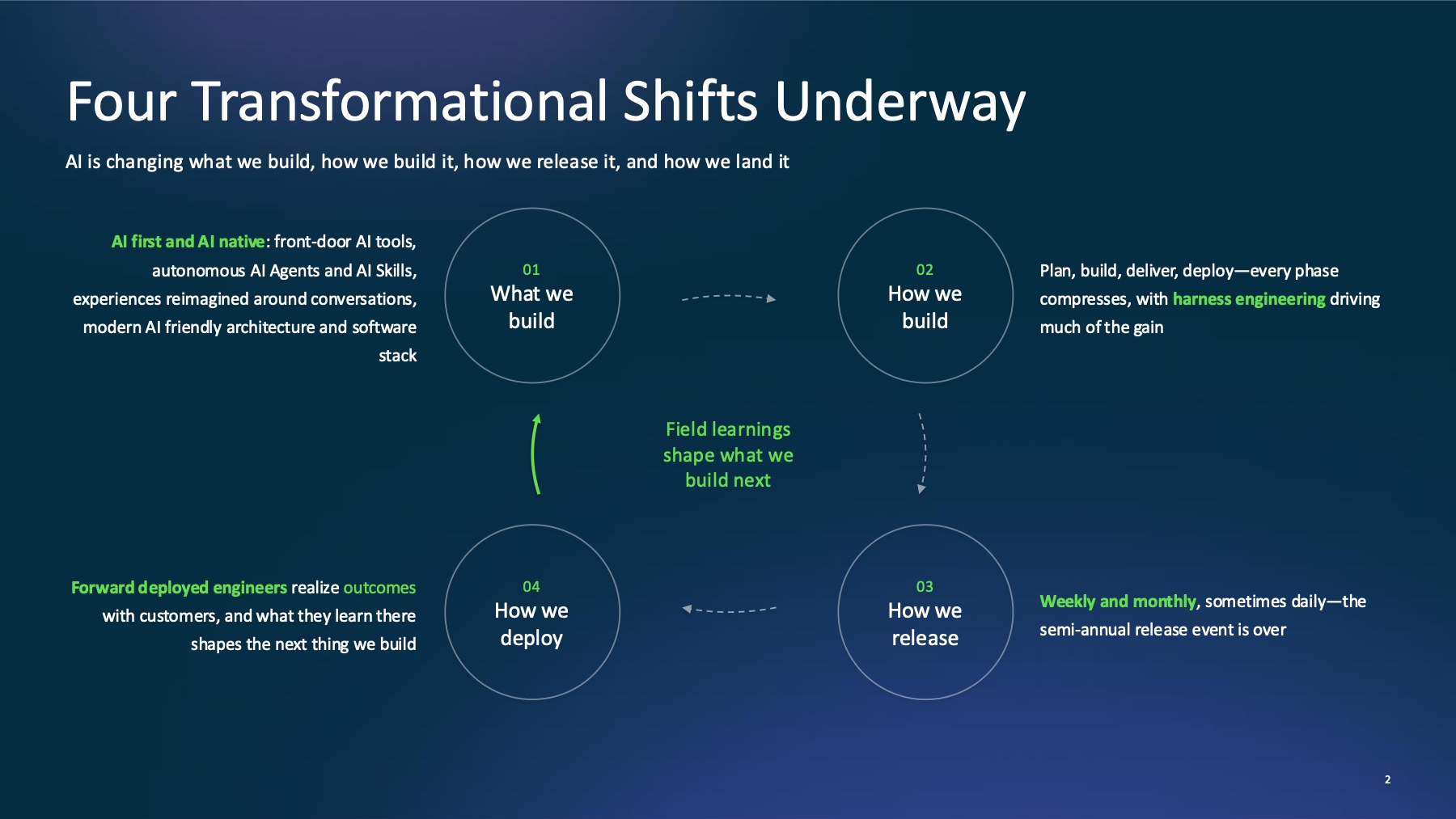
AI is changing what we build, how we build it, how we release it, and how we land it.
- What we build. AI first and AI native: front-door AI tools, autonomous AI Agents and AI Skills, experiences reimagined around conversations, modern AI friendly architecture and software stack.
- How we build. Plan, build, deliver, deploy - every phase compresses, with harness engineering driving much of the gain.
- How we release. Weekly and monthly, sometimes daily - the semi-annual release event is over.
- How we deploy. Forward deployed engineers realize outcomes with customers, and what they learn there shapes the next thing we build.
Field learnings shape what we build next.
Product transformation
Original presentation, slide 3.
Original presentation, slide 3.
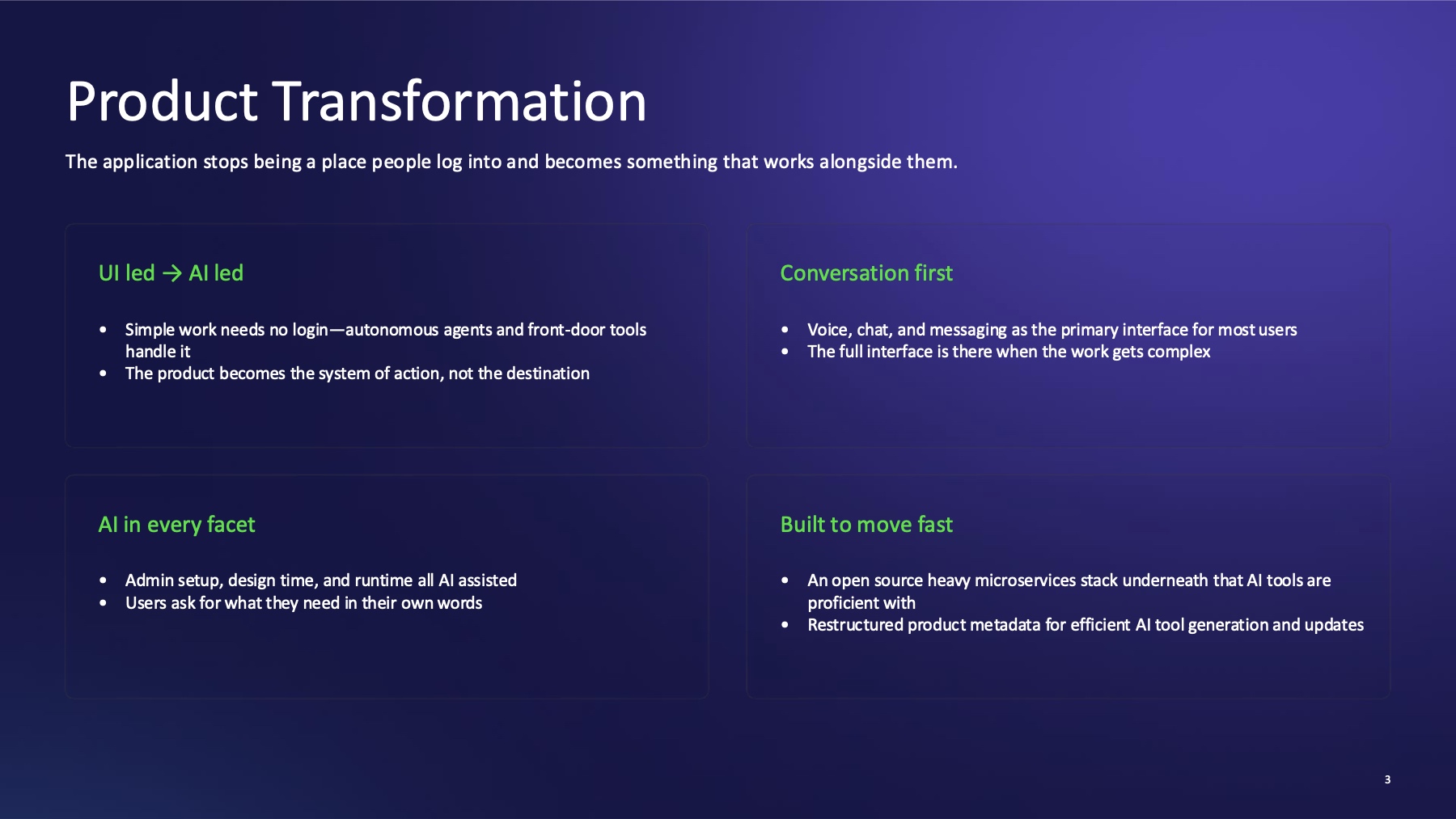
The application stops being a place people log into and becomes something that works alongside them.
- UI led → AI led. Simple work needs no login - autonomous agents and front-door tools handle it. The product becomes the system of action, not the destination.
- Conversation first. Voice, chat, and messaging as the primary interface for most users. The full interface is there when the work gets complex.
- AI in every facet. Admin setup, design time, and runtime all AI assisted. Users ask for what they need in their own words.
- Built to move fast. An open source heavy microservices stack underneath that AI tools are proficient with. Restructured product metadata for efficient AI tool generation and updates.
Every phase is compressing
Original presentation, slide 4.
Original presentation, slide 4.
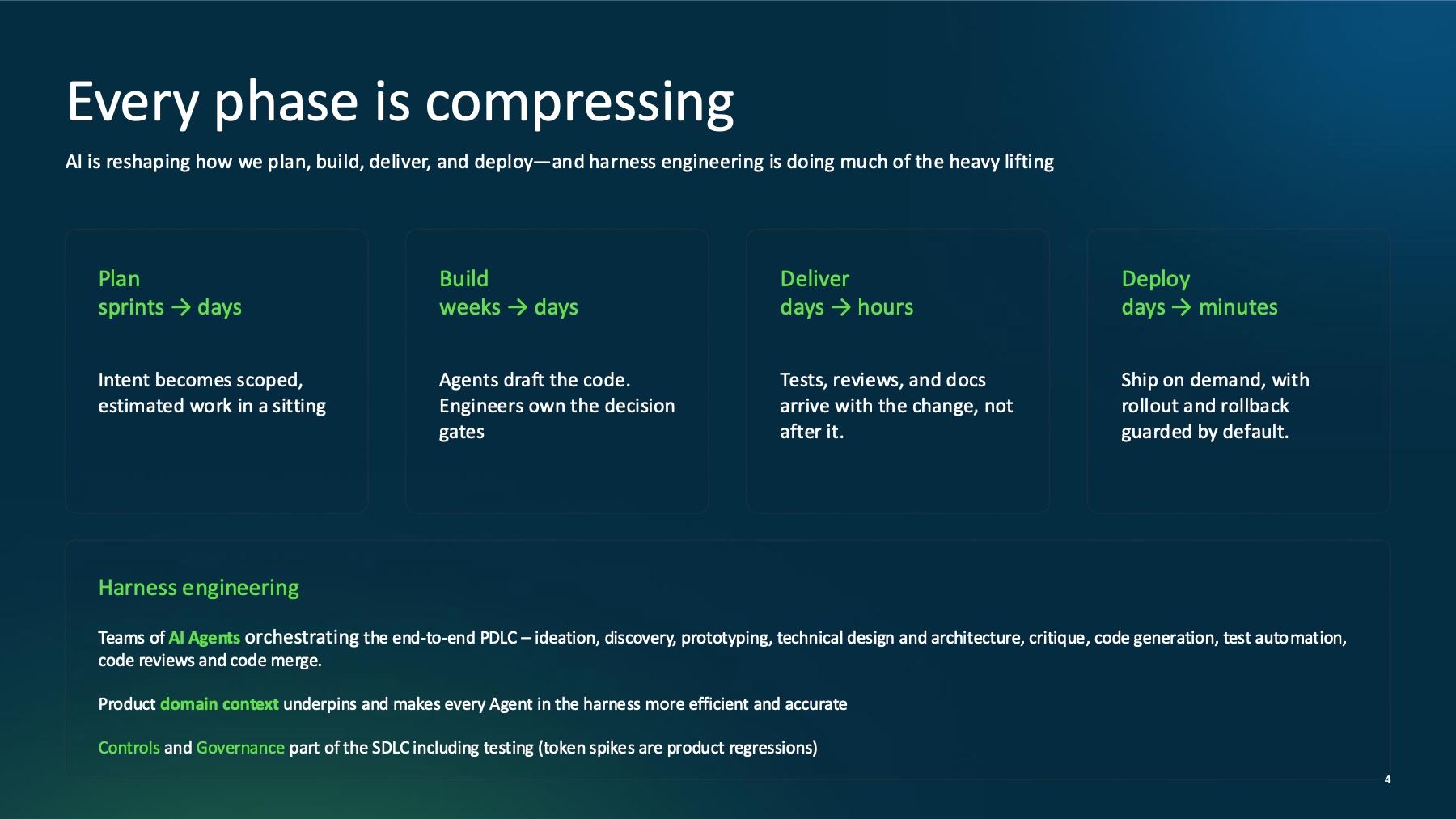
AI is reshaping how we plan, build, deliver, and deploy - and harness engineering is doing much of the heavy lifting.
- Plan: sprints → days. Intent becomes scoped, estimated work in a sitting.
- Build: weeks → days. Agents draft the code. Engineers own the decision gates.
- Deliver: days → hours. Tests, reviews, and docs arrive with the change, not after it.
- Deploy: days → minutes. Ship on demand, with rollout and rollback guarded by default.
Harness engineering
Teams of AI Agents orchestrating the end-to-end PDLC - ideation, discovery, prototyping, technical design and architecture, critique, code generation, test automation, code reviews and code merge.
Product domain context underpins and makes every Agent in the harness more efficient and accurate.
Controls and Governance part of the SDLC including testing (token spikes are product regressions).
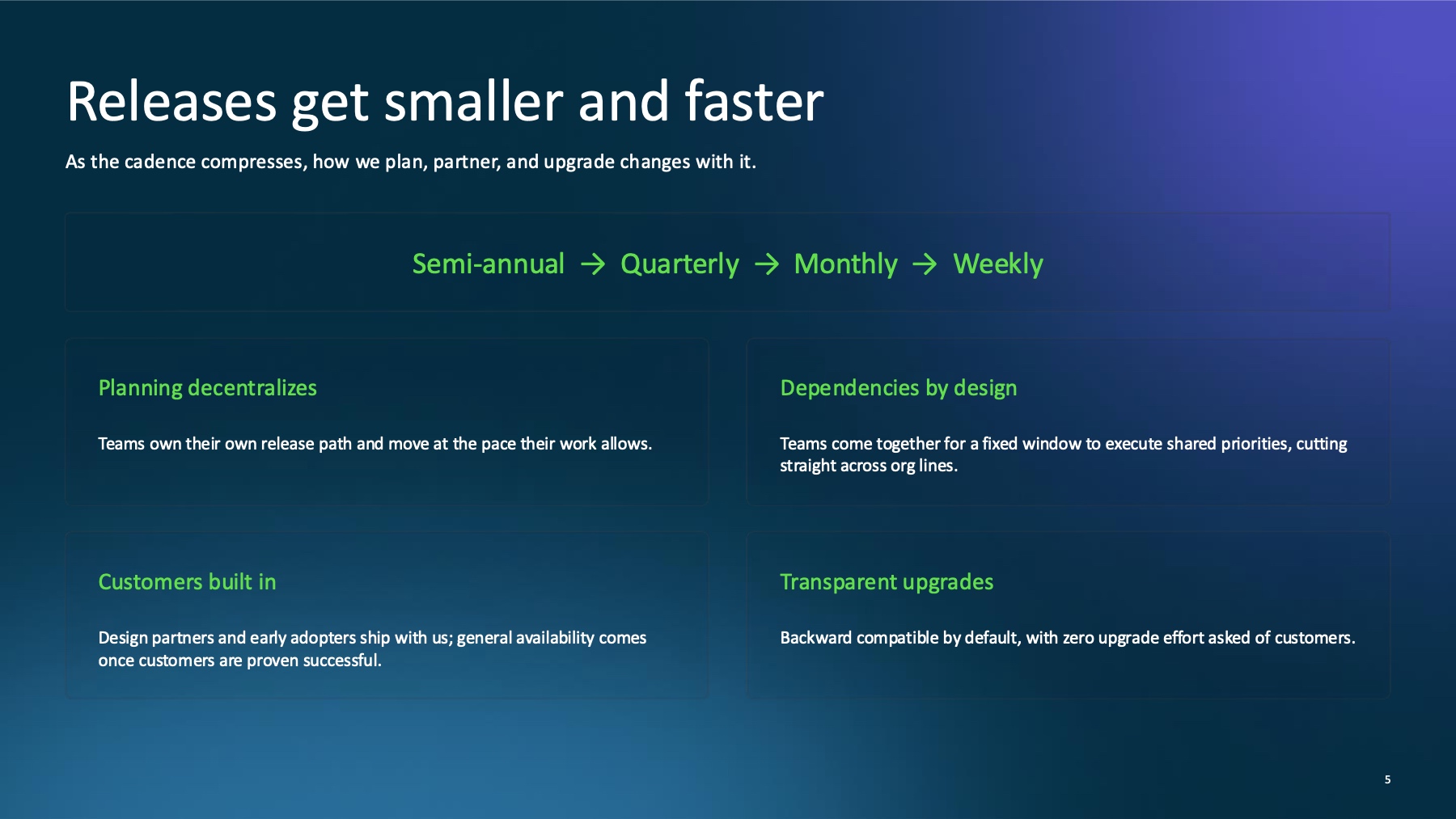
Releases get smaller and faster
Original presentation, slide 5.
Original presentation, slide 5.
As the cadence compresses, how we plan, partner, and upgrade changes with it.
Semi-annual → Quarterly → Monthly → Weekly
- Planning decentralizes. Teams own their own release path and move at the pace their work allows.
- Dependencies by design. Teams come together for a fixed window to execute shared priorities, cutting straight across org lines.
- Customers built in. Design partners and early adopters ship with us; general availability comes once customers are proven successful.
- Transparent upgrades. Backward compatible by default, with zero upgrade effort asked of customers.
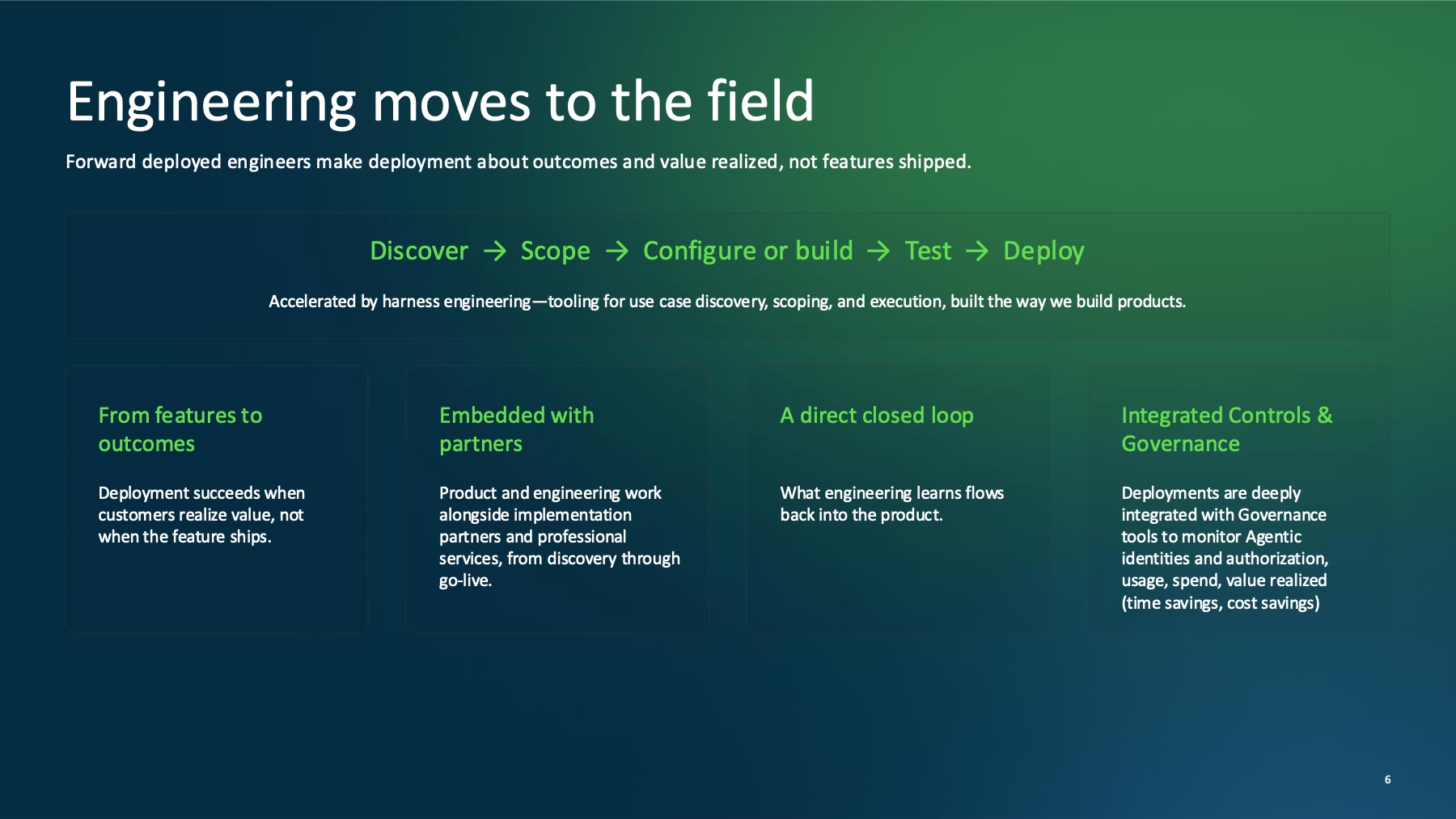
Engineering moves to the field
Original presentation, slide 6.
Original presentation, slide 6.
Forward deployed engineers make deployment about outcomes and value realized, not features shipped.
Discover → Scope → Configure or build → Test → Deploy
Accelerated by harness engineering - tooling for use case discovery, scoping, and execution, built the way we build products.
- From features to outcomes. Deployment succeeds when customers realize value, not when the feature ships.
- Embedded with partners. Product and engineering work alongside implementation partners and professional services, from discovery through go-live.
- A direct closed loop. What engineering learns flows back into the product.
- Integrated Controls & Governance. Deployments are deeply integrated with Governance tools to monitor Agentic identities and authorization, usage, spend, value realized (time savings, cost savings).
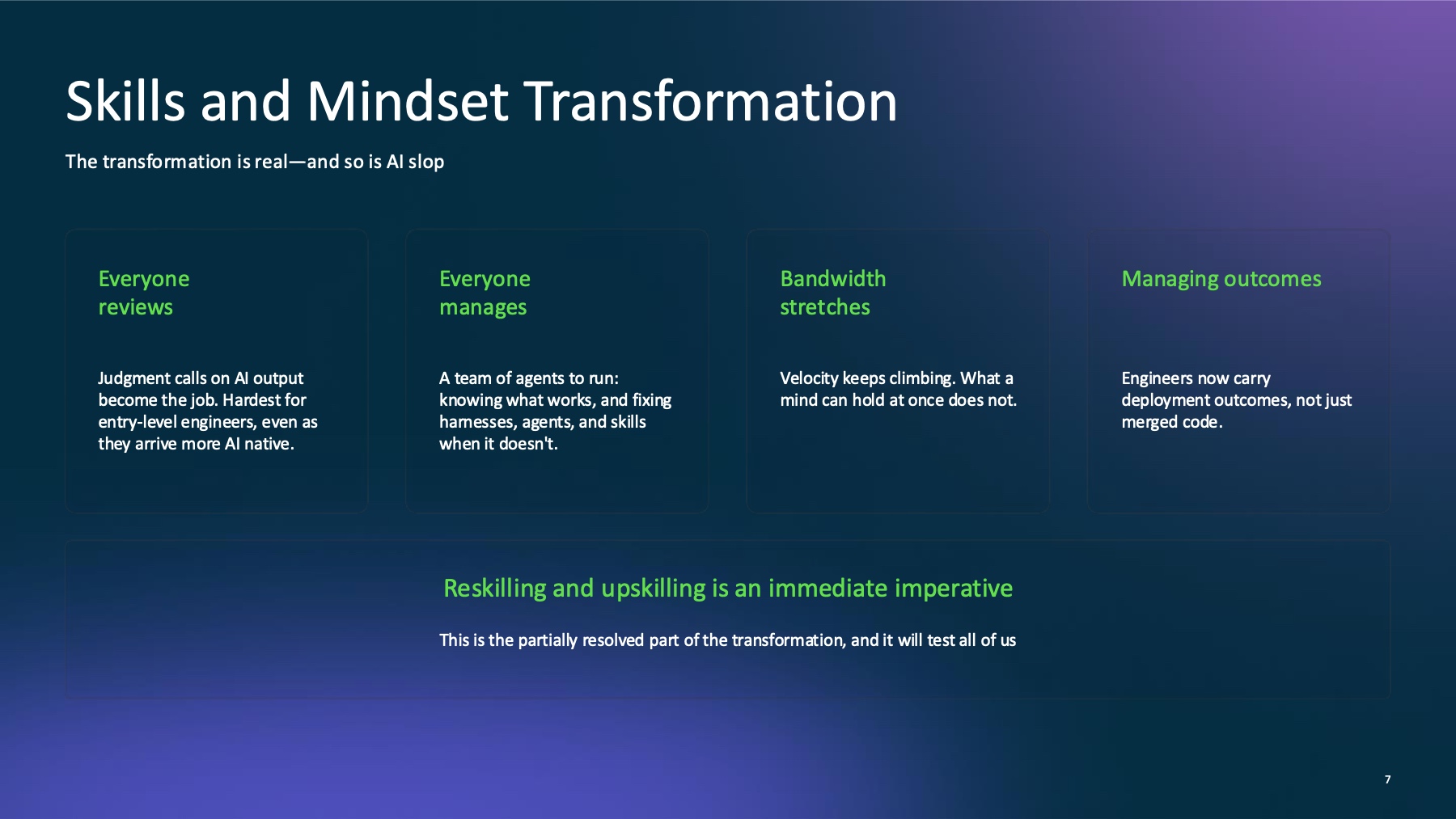
Skills and mindset transformation
Original presentation, slide 7.
Original presentation, slide 7.
The transformation is real - and so is AI slop.
- Everyone reviews. Judgment calls on AI output become the job. Hardest for entry-level engineers, even as they arrive more AI native.
- Everyone manages. A team of agents to run: knowing what works, and fixing harnesses, agents, and skills when it does not.
- Bandwidth stretches. Velocity keeps climbing. What a mind can hold at once does not.
- Managing outcomes. Engineers now carry deployment outcomes, not just merged code.
Reskilling and upskilling is an immediate imperative.
This is the partially resolved part of the transformation, and it will test all of us.
Thank you
Download
More perspectives on AI, customer value, and customer leadership at SuccessLab . Join the SuccessLab community .
Comments (0)
Popular

Dive in
Related
Blog
Show the Work: What SaaS and AI Product Demos Must Prove
By Omid Razavi • Aug 23rd, 2026 • Views 3
Blog
Show the Work: What SaaS and AI Product Demos Must Prove
By Omid Razavi • Aug 23rd, 2026 • Views 3