

Customer Leadership & Strategy
November 4, 2026
Organizing for Customer Outcomes
# Operating Models
# Customer Value
# Executive Leadership
Clear ownership, connected delivery, accountable leadership, and verified results.

Omid Razavi
Each contribution to a customer outcome usually has an owner. The connections between them often do not.
AI can carry more work across those connections. Products can guide onboarding. Service agents can retrieve customer context, update cases, and prepare communications. Systems can monitor signals and propose interventions. Leaders need to decide how that changes responsibilities, decision authority, staffing, and the evidence used to confirm results.
These perspectives draw on my direct experience at SuccessFactors, SAP, ServiceNow, and SupportLogic, and on what I have learned through interactions and shared experiences across the broader SuccessLab community.
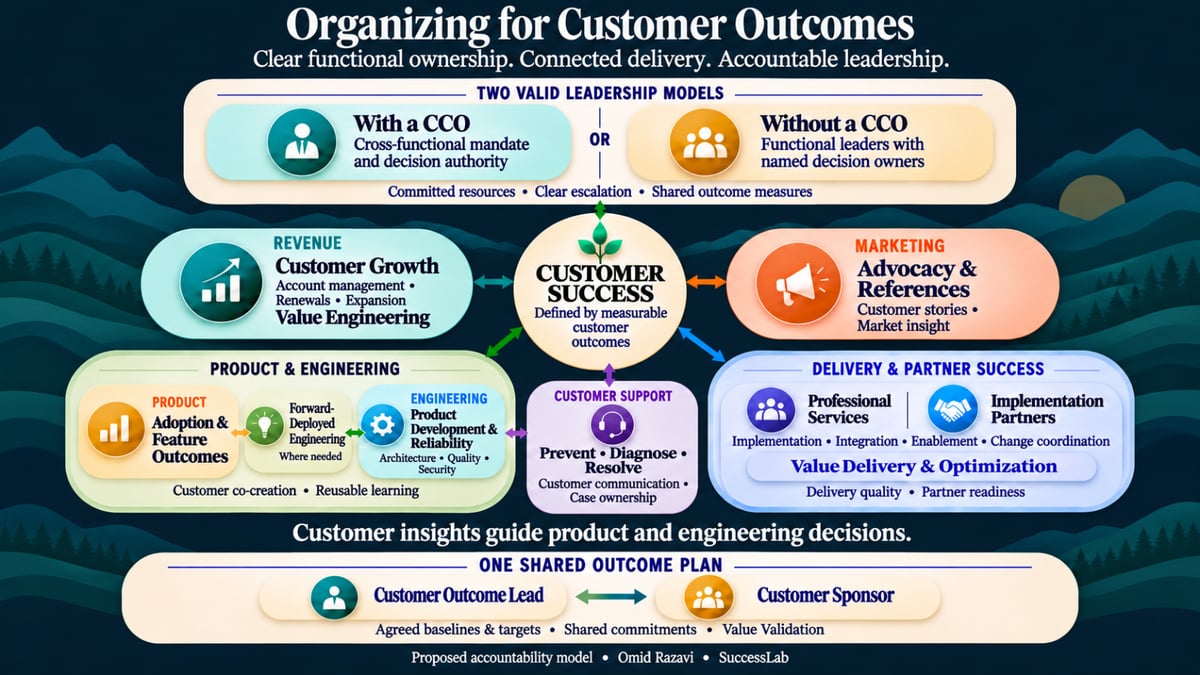
The model starts with Customer Success, defined by measurable customer outcomes. Each function contributes a different capability:
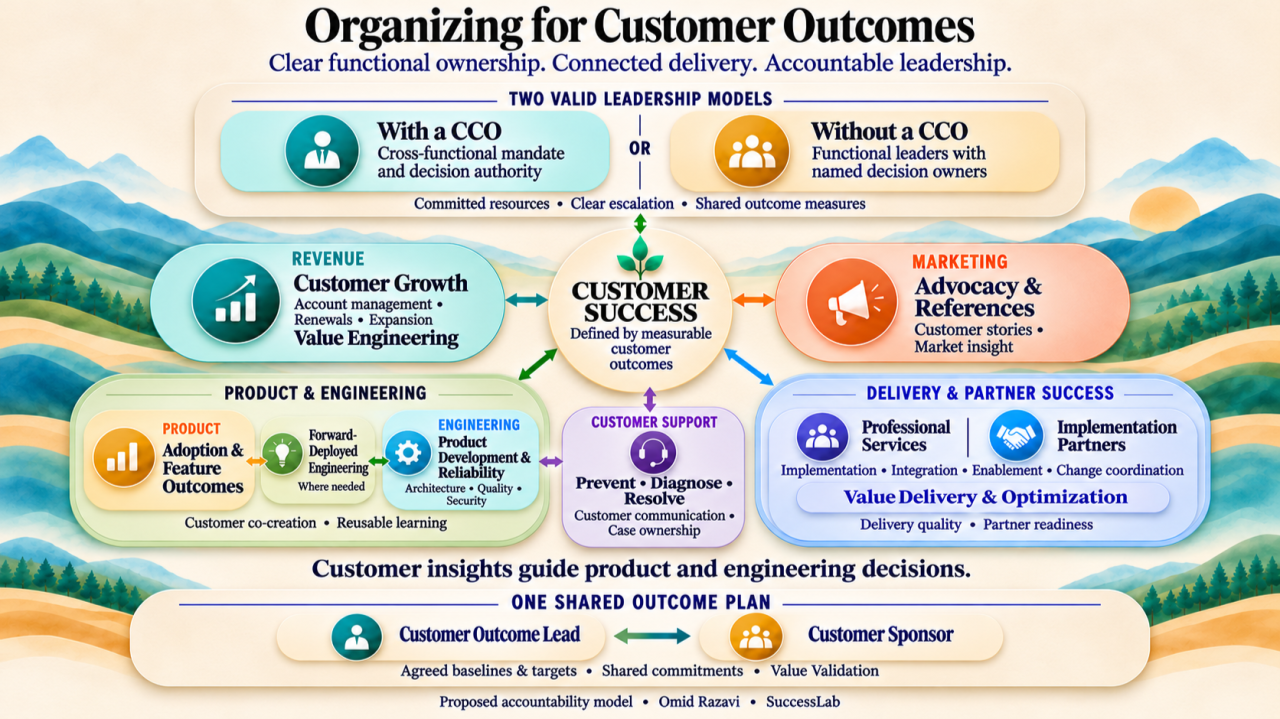
Organizing for customer outcomes. Source: Omid Razavi / SuccessLab.
- Revenue: Customer Growth. Account management, renewals, expansion, and Value Engineering.
- Marketing: Advocacy & References. Customer stories and market insight.
- Product & Engineering. Product owns Adoption & Feature Outcomes. Engineering owns product development and reliability, including architecture, quality, and security. Forward-Deployed Engineering contributes where needed. Customer co-creation and reusable learning connect the work.
- Customer Support: Prevent, Diagnose, Resolve. Customer communication and case ownership maintain continuity through the issue.
- Delivery & Partner Success: Value delivery and optimization. Professional Services and Implementation Partners contribute implementation, integration, enablement, and change coordination, with attention to delivery quality and partner readiness.
Each function needs a charter covering its responsibilities, decisions, measures, and commitments to other teams. One person may carry several functions in a smaller company. In a larger organization, several teams may contribute to one function.
Choosing the leadership model
A dedicated Customer Success organization and a CCO are separate choices. The model applies with a dedicated CS organization or with responsibilities distributed across existing functions. Either arrangement can operate with or without a CCO.
With a CCO, the role carries a cross-functional mandate and decision authority to secure commitments and resolve trade-offs.
Without a CCO, functional leaders need named decision owners and an explicit agreement on how priorities, resources, and dependencies will be managed.
Both models require committed resources, clear escalation, and shared outcome measures.
How AI changes execution
AI changes where execution belongs. When onboarding and guidance become product capabilities, Product needs to own their performance. When agents investigate support issues, experienced engineers can spend more time improving knowledge, evaluating diagnosis, and handling exceptions. Leaders should review work that can be absorbed into the product, automated, combined, or assigned differently. That review should happen before staffing decisions.
Delegated work needs explicit limits. For each agent, agree on its purpose, approved actions, permitted data, conditions for human intervention, and completion checks. Functional leaders remain responsible for the policies and knowledge used in their work. Technical teams implement and test the controls. Current agent design guidance makes clear that behavior depends on the model, instructions, tools, and environment together.
The customer context must travel with the work. Commercial commitments, product configuration, previous actions, customer constraints, and outstanding decisions need authoritative records and clear ownership. An agent taking over a task needs enough history to continue safely. The receiving team needs the same continuity.
A shared outcome plan
One shared outcome plan connects execution to the customer result. A Customer Outcome Lead follows the provider’s commitments and coordinates dependencies. A Customer Sponsor brings the decisions, resources, and commitments required on the customer’s side. Together, they agree on baselines, targets, shared commitments, and value validation.
The lead’s authority must match the provider commitments being made. Customer decisions and process changes remain with the customer’s authorized leaders. The plan should show those dependencies and how progress will be reviewed.
That plan should reduce duplicated account planning, executive reviews, adoption programs, and renewal forecasting. Give each shared activity a designated lead, defined contributions, and a common record. At each transition, name the receiving owner, required information, and completion criteria. Delivery must accept sales commitments. A workaround needs an owner for the permanent correction. Customer value needs review before renewal.
Verify the customer result
Verification needs to follow the customer’s work. For an order-synchronization incident, check that new orders flow, the backlog is reconciled, and any permanent correction remains owned. In a customer success engagement, check the agreed operational improvement and review its contribution to the business objective with the customer. Record completed tasks, operational results, and business outcomes separately.
Customer insights must also reach Product and Engineering with enough evidence and priority to influence decisions. Recurring issues, adoption friction, and implementation obstacles should inform product improvements and partner practices. Customers should see what changed because of what they shared.
AI also changes coverage costs. Evaluate model and platform usage, integration, knowledge maintenance, human review, exceptions, and rework alongside capacity released. Track cost per verified resolution where resolution is well defined. For broader customer outcomes, agree on scope and contribution before assigning costs or claiming returns. Any released capacity needs an explicit decision on redeployment, growth, or savings.
Company stage, product category, and customer readiness still shape the design. Application SaaS may emphasize adoption and workflow change. Infrastructure may emphasize architecture, reliability, and consumption economics. Hardware adds deployment and field service. Cybersecurity adds preparedness and resilience. AI adoption should reflect the customer’s environment, technical readiness, and the consequences of a wrong move.
The leadership task is to keep responsibilities, authority, resources, and measures current as the work changes.
Keep the operating model current
Customer organizations are dynamic. Their responsibilities and boundaries change as companies grow, products mature, customer expectations shift, partners develop capabilities, and AI changes how work gets done.
No structure is universally right or wrong. What works well for one organization may be a mistake for another, and a successful model can become a constraint as the business evolves. Leaders need to keep testing whether roles, authority, resources, and incentives remain suited to the work, while reducing duplication and closing gaps.
Where do you think customer organizations are heading as AI takes on more execution, and who will be accountable for the customer result?
Original publication
Comments (0)
Popular

Dive in
Related
Blog
Operationalizing Customer Value at Scale: Turning Outcomes Into the New Growth Engine
Nov 7th, 2025 • Views 9
Blog
People First, Outcomes Always: Bryan Belmont’s Blueprint for Leadership in the AI Era
May 8th, 2025 • Views 6
Blog
Operationalizing Customer Value at Scale: Turning Outcomes Into the New Growth Engine
Nov 7th, 2025 • Views 9
Blog
People First, Outcomes Always: Bryan Belmont’s Blueprint for Leadership in the AI Era
May 8th, 2025 • Views 6