

AI Strategy & Technology
October 3, 2026
When Your CEO Wants Another AI Vendor

# AI ROI
# Executive Leadership
A practical approach to comparing capability, economics, and the case for change.

Omid Razavi
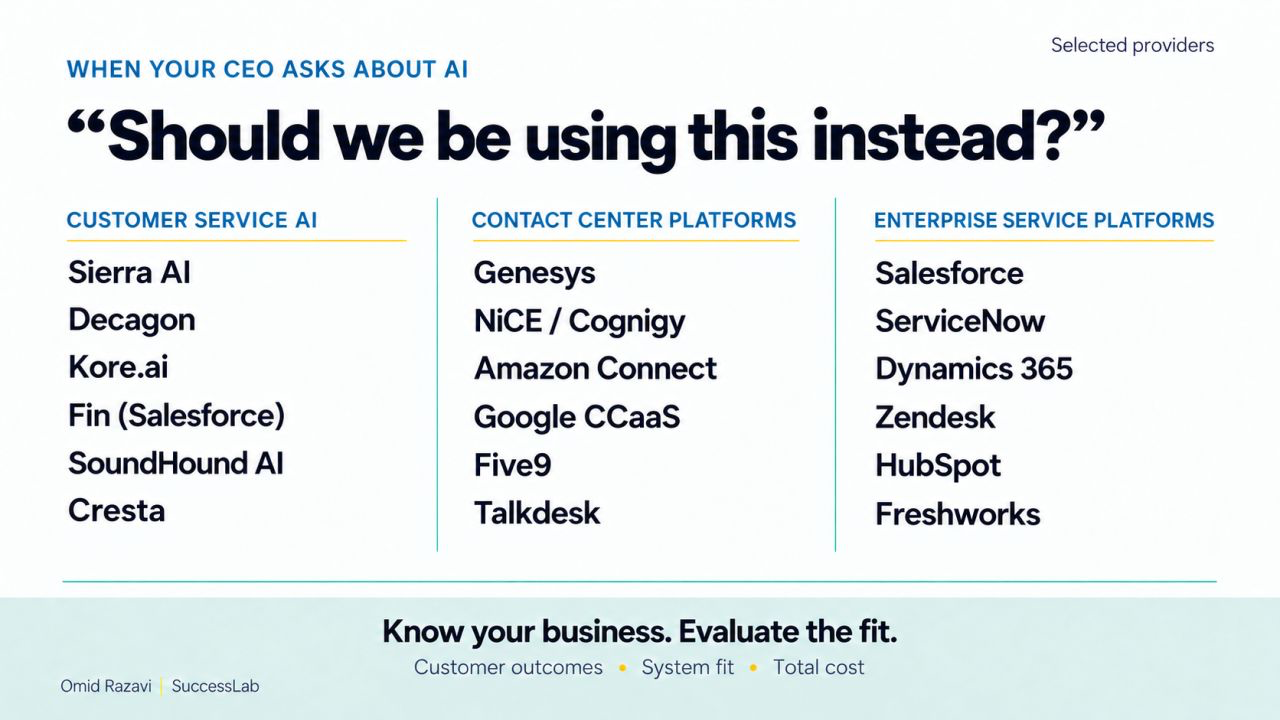
Imagine your CEO comes back from a conversation with Sierra’s Bret Taylor, or a demo of Decagon’s AI agents, and asks:
“Should we be doing this instead?”
Evaluating a new AI vendor in the context of the work and economics. Original LinkedIn illustration.
That question can put you on the spot, even when your AI program is delivering.
At SuccessLab, I regularly speak with customer service and support leaders about where to invest in AI, how to organize their teams, and how to improve service, retain customers, and show business results.
A recent conversation with a support leader under pressure to add another vendor to an evaluation already underway brought these decisions into focus.
Here is how I would approach it.
1. Define the opportunity.
What caught the CEO’s attention: lower cost, better service, or faster progress? Identify the improvement you need and whether it warrants another evaluation. You might replace a solution, add a capability, or continue the current plan.
2. Test the work you need it to do.
Can the AI resolve an account-specific issue across your systems, respect customer permissions, and hand over an exception with enough context for someone to finish the job? Request evidence from representative cases, using the same standards as your current approach.
3. Show your progress and the economics.
Bring current results and remaining gaps. Compare resolution quality, repeat contacts, customer effort, and total cost.
Include integration, migration, retraining, maintenance, and human effort. Automating easy contacts can leave your team with a harder workload. Explain whether released capacity will reduce costs, avoid hiring, or improve service elsewhere.
4. Define what you are paying for.
Outcome-based pricing works best when results are measurable, verifiable, and reasonably attributable to the AI. A completed transaction can qualify, provided it meets agreed quality standards and delivers value.
Would the customer have completed it through existing self-service? Compare any improvement in completion rates, customer effort, and cost against that baseline.
Agree upfront on what a successful resolution looks like, who verifies it, and how repeat contacts affect billing. When the AI’s contribution is difficult to isolate or verify, subscription, usage, or hybrid pricing may fit better.
5. Return with a recommendation.
“Our current approach is delivering [X]. Our main gap is [Y]. I recommend continuing the rollout while we assess whether this vendor offers enough improvement on [Y] to warrant a focused test. I'll return by [date] with the results, a recommendation, and the full cost of any change.”
Regular, concise updates keep the C-suite informed of your progress and priorities, so the next compelling vendor conversation or demo can be assessed in context.
Know your business. Show your progress. Stay open to better options. Be clear about what would justify a change.
How are you handling these conversations?
Original publication
Comments (0)
Popular

Dive in
Related
Blog
When Your Company Pivots, What Do You Still Owe Your Customers?
By Omid Razavi • Sep 17th, 2026 • Views 3
Blog
Stop Shipping Friction: Make AI-Enabled Onboarding Your #1 AI Investment
Jul 25th, 2025 • Views 8
Blog
"Am I Talking to a Robot?" When AI Sounds So Human, Even Humans Get Confused
Jun 28th, 2025 • Views 8
Blog
When Your Company Pivots, What Do You Still Owe Your Customers?
By Omid Razavi • Sep 17th, 2026 • Views 3
Blog
Stop Shipping Friction: Make AI-Enabled Onboarding Your #1 AI Investment
Jul 25th, 2025 • Views 8
Blog
"Am I Talking to a Robot?" When AI Sounds So Human, Even Humans Get Confused
Jun 28th, 2025 • Views 8