

Customer Leadership & Strategy
June 29, 2026
Five Decisions That Turn AI Ambition into Business Impact
# AI Adoption
# AI ROI
# Decision-Making
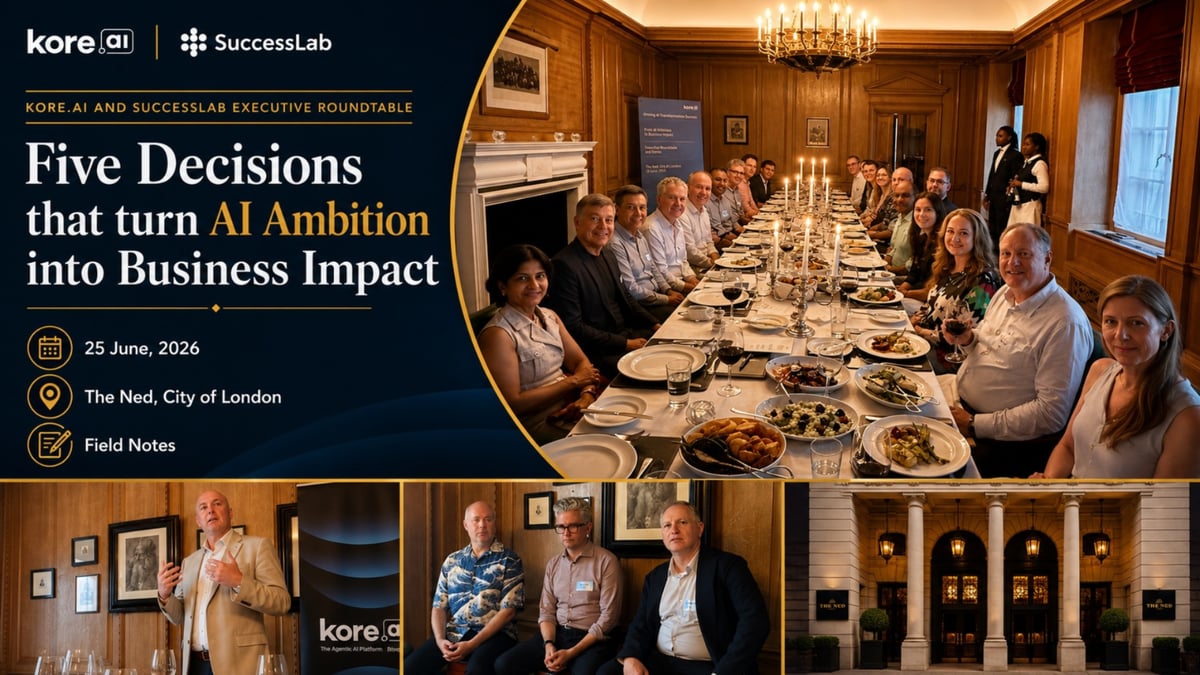
Field notes from the SuccessLab Executive Roundtable at the Ned, London

Omid Razavi
AI ambition is everywhere. Business impact is rarer. At a private executive roundtable hosted with Kore.ai at The Ned in London, senior leaders compared where AI is creating measurable value and where programs stall. Five decisions separated the two: start with the outcome, keep accountability with the business, treat data as part of the work, build for continuous change, and move from individual productivity to team intelligence.
AI ambition is abundant. Enterprise impact is not.
That gap defined Driving AI Transformation Success: From Initiatives to Business Impact, a private executive roundtable and dinner hosted by Kore.ai and SuccessLab at The Ned in London.
Senior leaders from banking, insurance, retail, payments, consulting, enterprise software, AI, and customer operations compared where AI is creating measurable value, where programs are stalling, and what must change to scale.
Cathal McCarthy moderated the discussion with Ted Shelton, Nick Clark, and Marc Massar. Five decisions stood out.
DECISION ONE
Start with the business outcome
Ask what AI will materially improve before choosing the model, platform, or vendor.
Many AI programs still begin with the technology. Stronger programs begin with an outcome.
Nick Clark shared examples of AI reducing service costs and exposing unmet customer demand. Ted Shelton described how AI can compress complex regulatory work from months to weeks, creating both economic value and faster access to treatments. The value did not come from the model alone. It came from applying AI to a material business problem.
Productivity is part of the case, but rarely the whole case. AI may also create value through lower cost, faster growth, shorter cycle times, stronger retention, lower risk, and earlier identification of opportunity.
“What outcome becomes materially better because of AI?”
That question should come before model, platform, or vendor selection. It should also clarify how the value will be used. Will capacity be captured as savings, reinvested in growth, redirected toward higher-value work, or divided among several priorities?
DECISION TWO
Keep accountability with the business
Clarify who owns the outcome, including its accuracy, safety, and consequences.
AI agents increasingly do more than assist. They summarize evidence, identify exceptions, recommend actions, trigger workflows, and make decisions previously handled by people.
Nick Clark argued that once an AI-enabled workflow enters production, the business must own its end-to-end performance. Technology teams may manage architecture, availability, latency, and cost, but the business remains accountable for whether the outcome is correct, safe, and appropriate. Marc Massar reinforced the point from a regulated-industry perspective. The obligation concerns the outcome delivered to the customer, not the tool used to produce it.
“Do not ask who owns the AI. Ask who owns the outcome.”
Accountability cannot be transferred to the model or delegated to a vendor. Risk, legal, data, procurement, and technology all have roles. Governance should begin with business ownership of the outcome, then define decision rights, controls, escalation paths, and human intervention.
DECISION THREE
Treat data readiness as part of the work
Make each decision's data reliable enough to act on.
Poor data remains one of the clearest constraints on enterprise AI. Marc Massar warned against placing sophisticated agentic workflows on top of outdated, fragmented, or unreliable information. Weak data can amplify operational risk.
But data quality can also become an excuse to delay. Most organizations will never reach a point where every source is complete, current, and fully governed. A more practical approach is to begin with a bounded outcome, identify the data required to support it, and make its quality visible.
“Do not wait for perfect data. Make the required data reliable enough for the decision at hand.”
This makes data improvement part of the transformation rather than a condition that must be completed first.
DECISION FOUR
Build for continuous change
Build governance and architecture that can adapt safely as models, costs, and regulations change.
AI systems will not remain stable. Models change. Costs move. Vendors introduce and withdraw capabilities. Regulations evolve. Performance can improve or decline as data, knowledge, and customer behavior shift.
Ted Shelton advised leaders to avoid projects whose outcomes sit too far into the future. Organizations need shorter execution cycles because both the technology and the choices available will continue to change. Nick Clark emphasized governance as the structure that allows change without losing control. Marc Massar stressed architectural resilience and warned against treating model selection as permanent.
One practical approach is to begin with the strongest available capability to establish what is possible, then optimize for cost, latency, and performance.
“AI strategy needs a clear direction and an adaptable execution model.”
Governance should enable change safely, not freeze the organization around today's tools.
DECISION FIVE
Move from individual productivity to team intelligence
Help teams think and decide better together.
Most AI tools are designed around the individual. They help one person write faster, analyze more information, or complete a task more efficiently.
Ted Shelton argued that this is only the first stage. Organizations create value through teams, shared context, and collective learning. If AI improves individuals but isolates knowledge inside separate human-machine interactions, part of that value is lost. The next phase will involve AI that supports teams: capturing institutional memory, sharing useful context, routing expertise, and helping groups make better decisions together.
“The next productivity gain will come from improving how teams think, not only how individuals work.”
The leadership question is no longer only how AI helps each employee work faster. It is how AI strengthens collective judgment.
What becomes more valuable for people
Ted Shelton pushed the discussion beyond implementation to the role of people in an AI-enabled organization. As machines take on more work, three human capabilities gain value: owning the outcome, framing the problem, and earning trust.
Owning the outcome. People remain responsible for outcomes and consequences. That requires judgment, systems thinking, and the ability to challenge how an AI system reached a decision.
Framing the problem. AI can generate and produce at extraordinary speed. Human value lies in framing the problem, interpreting context, and deciding what is worth creating.
Earning trust. AI can support conversations and simulate understanding. Trust between people still depends on shared experience, genuine responsibility, and mutual consequence.
These capabilities should be designed into future roles, leadership development, and operating models.
What executive leaders should decide
The discussion left five practical questions. Which business outcome are we improving, and how will we measure it? Who remains accountable when an AI-enabled process produces a decision or action? What data must be reliable for this outcome, and who owns its quality? Can our architecture and governance adapt as models, costs, and regulations change? And are we using AI to improve team intelligence as well as individual productivity?
AI transformation will not be measured by the number of pilots launched. It will be measured by whether organizations convert new capabilities into better decisions, stronger performance, and durable operating change.
WITH THANKS Grateful to Cathal McCarthy for moderating, and to Ted Shelton, Nick Clark, and Marc Massar for the depth and challenge they brought to the discussion. Thank you to David Schreffler, Theo Baxter, Christie Dahmen, Komal Joshi, Sarmeyah Kugadasan, and the Kore.ai team for partnering with SuccessLab to host the event. And thank you to every leader around the table for the candor of the conversation.
We continue the conversation in a live online session on 21 July, focused on what it takes to translate AI initiatives into measurable enterprise impact. Register at lu.ma/ai217.
ABOUT THE AUTHOR Omid Razavi, Ph.D., is the founder of SuccessLab and the author of CCO Perspectives. He has spent more than thirty years in enterprise software, in customer success, support, and service leadership roles at companies including ServiceNow, SAP, and SupportLogic. Through SuccessLab, he convenes senior customer, revenue, and technology leaders across the United States and Europe to work through the decisions that shape the next operating model for customer-facing organizations.
SuccessLab is a community and advisory brand at the intersection of AI transformation and enterprise customer leadership. It runs the SuccessLab Executive Forums and Roundtables, publishes practitioner-level field notes and analysis under CCO Perspectives, and brings revenue and customer leaders together to learn from one another as AI reshapes how service is designed, delivered, and valued.
Subscribe to CCO Perspectives and join the community at community.successlab.us.
Download
More perspectives on AI, customer value, and customer leadership at SuccessLab . Join the SuccessLab community .
1
Comments (0)
Popular

Dive in
Related
Blog
Three Decisions That Will Define the AI-Enabled Service Organization
By Omid Razavi • Jun 29th, 2026 • Views 40
Blog
Generative AI and Business Analytics: Journey from Insights to Autonomy
By Omid Razavi • Mar 10th, 2024 • Views 2
Blog
Three Decisions That Will Define the AI-Enabled Service Organization
By Omid Razavi • Jun 29th, 2026 • Views 40
Blog
Generative AI and Business Analytics: Journey from Insights to Autonomy
By Omid Razavi • Mar 10th, 2024 • Views 2