

AI Strategy & Technology
August 27, 2026
When Agents Become the Interface, Products Compete on Trust

# Agentic AI
# Enterprise AI
# Customer Trust
Context, authority, reliable execution, and evidence become product requirements.

Omid Razavi
Agents Are Becoming the Interface. Products Will Compete on Trust.
For decades, people adapted their work to software. Agents change that relationship. Software must now interpret human intent, assemble the right context, and act within the authority it has been given.
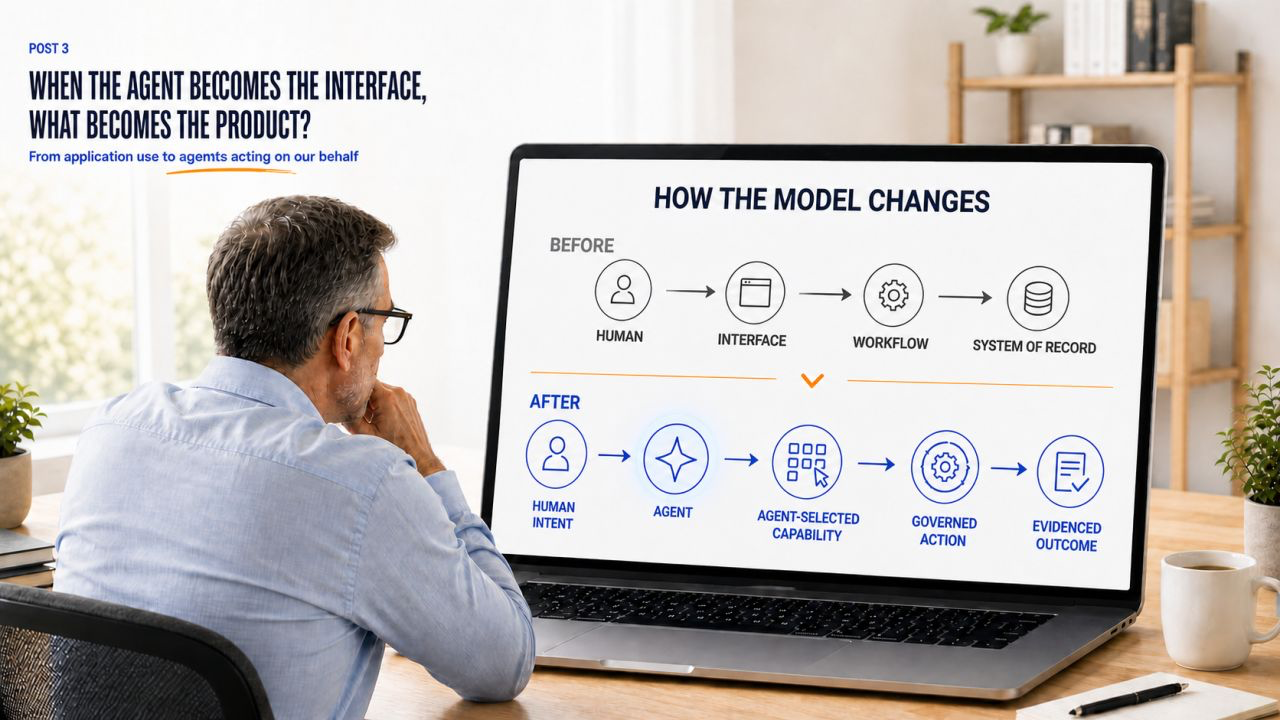
From human intent to governed action and an evidenced outcome. Original LinkedIn illustration.
That changes the interface, the product, and what enterprises must trust it to do.
The current model is:
Human → interface → workflow → system of record
The emerging model is:
Human intent → agent → agent-selected capability → governed action → evidenced outcome
Here is how I see it. People define the objective. The agent interprets their intent and assembles the relevant context. The enterprise determines which capabilities are available and establishes the boundaries for their use. The agent selects a capability, takes action within those boundaries, and preserves evidence of the outcome.
Enterprises will continue to select, purchase, and govern software. Agents will increasingly select which authorized capability to use for each task.
Consider a customer requesting an exception to a renewal policy.
An agent may assemble the contract, account history, product usage, prior commitments, and approval limits. That raises three questions:
- May the agent act, and under whose authority?
- When must it involve a person?
- Can the action be explained, reviewed, or reversed?
An API makes a function callable. Authority defines when, why, and within what boundaries it may be used.
One issue keeps surfacing in our SuccessLab discussions: access is getting easier, while authority remains unresolved.
The interface still matters. Its role will increasingly center on reviewing reasoning, approving commitments, resolving exceptions, and intervening when judgment is required.
Products will be judged at two moments. First, when the enterprise decides what to buy and govern. Then, each time an agent selects a capability.
At that second moment, the dashboard matters less. What matters is whether the capability is relevant, authorized, reliable, and able to show what happened.
For product leaders, trust will depend on context, clear boundaries, reliable execution, and evidence of the outcome.
What makes your product trustworthy when an agent acts through it?
Original publication
Comments (0)
Popular

Dive in
Related
Blog
Inside ServiceNow: Rohit Batra on the Future of Connected Service, Sales, and Success
Nov 17th, 2025 • Views 18
Blog
Insights from the Top: John Sabino on Leadership and Transformation
By Omid Razavi • Dec 20th, 2023 • Views 3
Blog
Insights from the Top: John Sabino on Leadership and Transformation
By Omid Razavi • Dec 20th, 2023 • Views 3
Blog
Inside ServiceNow: Rohit Batra on the Future of Connected Service, Sales, and Success
Nov 17th, 2025 • Views 18