

SuccessLab CS4Cyber — Leveraging AI for Business Transformation
# AI
Pragmatic learnings on the journey from AI experimentation to production
April 22, 2026
Opening Remarks
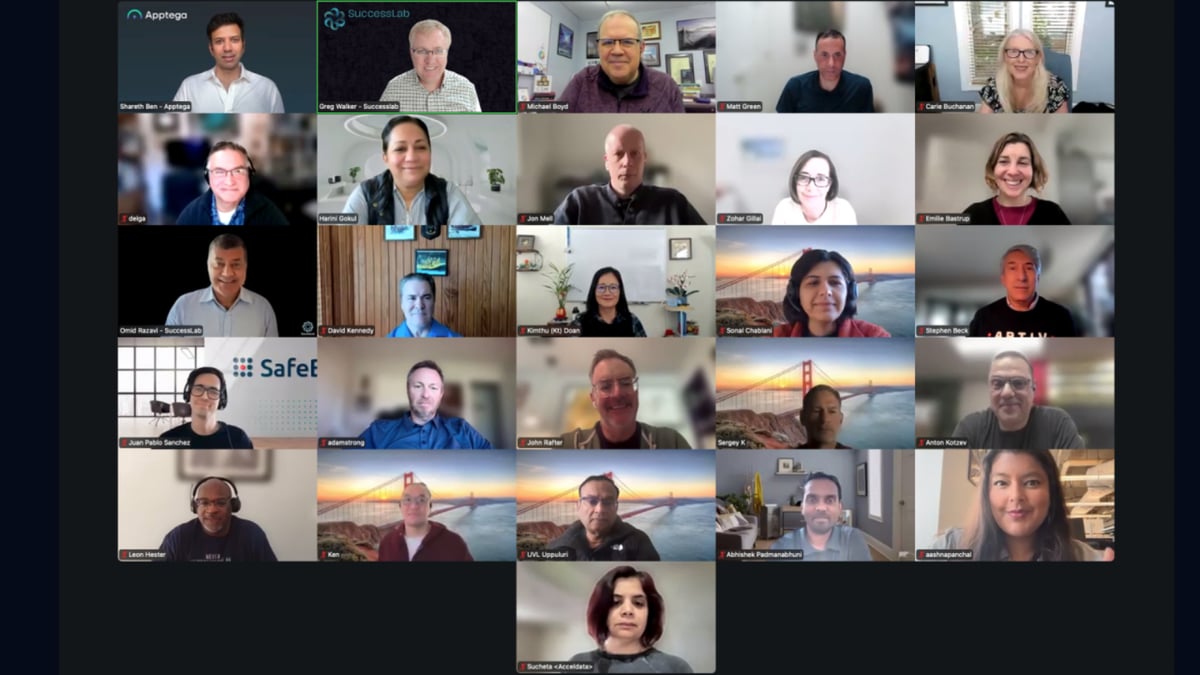
Omid Razavi: Happy Friday, everyone. We are excited to resume our CS4Cyber series. We met back in February, when we hosted three Chief Customer Officers from Netskope, Snyk, and Sophos. It is great to gather again with two outstanding leaders to continue the conversation around AI, customer success, and cybersecurity.
This session is being recorded, and thanks to our speakers, we will make the recording available afterward. We will also have time for Q&A. Many of you submitted questions in advance, and we will bring as many as we can into the discussion.
I am pleased to welcome my partner in this effort, Shareth Ben, who co-founded CS4Cyber with me. I am also very excited to welcome our guest, Harini Gokul, who has held leadership roles at Microsoft, AWS, and, more recently, Entrust as Chief Customer Officer. Both will share their perspectives on what it takes to achieve AI transformation, especially through the lens of customer-facing teams in cybersecurity.
Shareth, over to you.
Introductions
Shareth Ben: Thank you, Omid. Good morning and good afternoon, everyone. It is great to see some familiar faces here.
By way of introduction, I am Shareth Ben, Chief Customer Officer at Apptega. We are a GRC automation solutions provider. I have spent about 19 years in cybersecurity, always in customer-facing roles in one form or another, helping deliver critical software to enterprises and learning a great deal along the way.
One of the reasons Omid and I started CS4Cyber is that we wanted to create a community for customer success professionals in cybersecurity—people who serve CISOs and security teams, and who are navigating many of the same challenges. No one needs to go through this alone. Forums like this help us exchange ideas, learn from each other, and create a sense of collaboration and belonging.
Harini, welcome. We are very glad to have you with us.
Harini Gokul: Thank you, Omid, and thank you, Shareth. It is always good to be back. You are right—no one has to go on this journey alone, and this community is a testament to what you have built.
I am Harini Gokul. I have had the privilege of working with very smart people on important problems for many years. At Microsoft and AWS, we built the industry’s largest customer success organizations from the ground up and used them as strategic levers for growth. Those experiences taught me what scale, innovation, and ambition really look like.
At Entrust, I got a different kind of education: a masterclass in financial discipline, business rigor, and durable revenue growth. I also saw again how post-sales can become a strategic growth lever for the company.
With AI, we are at a moment where not only are our roles changing, but the work we do has become even more important. I am excited to be part of this conversation.
Part 1: Setting the Right Starting Point
Shareth Ben: I want to start with a couple of observations from what we are seeing. The desire to adopt AI is outpacing most companies’ ability to use it responsibly. Governance, responsible use, and measurement of business outcomes are all lagging. Many organizations are still experimenting and struggling to move from pilots into production at scale.
That raises a basic question: how is AI different from other technology shifts we have seen before? How is the way it is adopted, governed, and operationalized different?
Harini, you have been through several chapters of this journey already. What have you seen work? What have you seen not work? Let me start with a broad question: when you think about successful AI transformation, what determines success?
Harini Gokul: I think the frame you are using is the right one. How do we use this wave of innovation to make the highest and best use of our people while also delivering the highest and best value to our customers?
We have gone through disruptive shifts before. A few years ago, the conversation was cloud modernization. I remember talking to CIOs and CISOs about why they should move to the cloud, and often the early answers were narrow: “We will use it for disaster recovery,” or “We will use it for backup.” So we have seen technology shifts where the first step is limited imagination.
What is exciting about AI is that the unlock is far greater. The ability to do more, faster, and more efficiently than before is unlike anything we have seen. As a technologist, a recovering engineer, and someone who loves building and go-to-market work, I find this moment incredibly exciting.
But if I pull back to your question, I believe success starts with one core principle: can you connect AI back to the business outcomes you want for customers, the commercial outcomes you want for the company, and the people outcomes you want for your teams?
If you can work backward from those goals, you are in a much stronger position. That is true regardless of the generation of AI capability we are talking about, whether it is generative AI, copilots, or agentic AI. If you can connect the innovation to real goals, you have a foundation for success.
Part 2: Defining the North Star

Shareth Ben: That is a good setup. Let me make this more concrete. If we go back to the beginning of your AI transformation journey, what did the conversation look like between you, your leadership team, and the board? Was it centered on “What is our AI strategy?” or was it more focused on “What business problems are we trying to solve?”
Harini Gokul: There is a real difference between those two questions.
If I rewind about two years, I remember walking into a board meeting when we were just beginning to think seriously about the implications of generative AI. At that point, most of the innovation people were talking about was driven by ChatGPT. The board conversation raised more questions than answers.
How would this affect our customers? How should we build differently? What would this mean for our teams internally?
And to be honest, two years ago, I think most of us had more questions than answers.
Right after that board meeting, I went to an offsite with my leadership team. We rescheduled the agenda and spent four hours answering three questions.
First, strategically, if we got this right, what could we do for our customers and take to market that we could not do today?
Second, commercially, if we got this right, what better outcomes could we deliver? In my case, I was measured on GRR, NRR, and NPS, among other things, so we asked whether AI could materially improve those outcomes.
Third, from a talent and organizational standpoint, if we got this right, how could we make the highest and best use of our people?
That last question mattered because, like many organizations, we were under pressure to operate as efficiently as possible.
The easy thing would have been to move fast without much structure, especially when the board is asking for answers by the next meeting, and customers are also asking about your AI strategy. But moving fast without knowing where you are headed becomes expensive experimentation.
So we took the time to write a short mission statement. It was a few sentences, but it gave us a shared direction. In effect, it said we were going to use the AI capabilities available today, and those that would emerge in the future, to deliver more value to our customers, better commercial outcomes for the business, and better use of our people.
We published it, added it to the slides, and shared it with our teams. More than anything, it gave the organization a way to rally around a mission. AI was not the mission. AI was the means to an end.
Two years later, I am still glad we took that time. Every time we were deciding among options—tools, pilots, or investments—we came back to the same questions. It gave us guardrails and a real North Star.

Part 3: Cross-Functional Ownership and Bottom-Up Energy
Shareth Ben: Did you establish a formal AI governance working group or cross-functional team to guide this?
Harini Gokul: Yes, and I think that was important.
What I noticed early on was that there was both excitement and anxiety in the organization. Engineers were excited and wanted to experiment. At the same time, people had real questions: What does this mean for my role? How will it change the work I do?
We formed a cross-functional working group. We knew from day one that if we were going to do this responsibly, functions like security and information security had to be at the table early. We also needed business and customer leaders involved, because much of the transformation would happen in post-sales workflows.
When we started, the participants were primarily leaders from functions like technical support and professional services. But if I could do it again, I would go deeper into the organization earlier.
Much of the most creative experimentation and practical building was happening two levels down, often among early-career employees who were already experimenting on their own. In that sense, this became more of a bottom-up movement than a top-down mandate.
We had what we called a “tiger team” made up of people with a real passion for the topic. They were already building on the side, and they brought that energy into the company's mainstream. That mattered.
This was not a simple top-down order to “go do AI.” It worked better when it became a bottom-up effort within a clear strategic frame.
Part 4: Tying AI Work to Business Outcomes
Shareth Ben: You have spoken a lot about outcomes and workflows. How did you actually tie AI work back to hard metrics like GRR, NRR, or NPS?
Harini Gokul: That is the question every leader really wants answered.
After we aligned on the mission, the next step was to operationalize it. Among our post-sales teams, we identified more than 120 workflows across onboarding, technical support, and other areas. We needed a way to decide where to focus.
So we created a prioritization framework. We built a two-by-two matrix, and later even created a prioritization agent to help with that work.
One axis looked at the pain or upside associated with the workflow. Would solving it reduce major friction? Would it save money? Would it create top-line or bottom-line value?
The other axis looked at the type of AI capability we could realistically apply. I tend to think of AI maturity in three categories:
- Augment — AI helps a human do their job better
- Anticipate — AI helps predict and reason ahead
- Autonomous — AI can independently execute more of the workflow
We mapped workflows against those dimensions.
For example, quote-to-cash is an extremely painful process, but if you improve it materially, the upside is obvious in both revenue and productivity. Another example was risk scoring. We had health scores and customer success scores, but we did not have a strong pulse on overall risk. If we improve that, we can drive better retention and expansion.
Then we applied additional filters. The workflow had to be shared across more than one function to enable cross-functional adoption and joint ownership. It also had to be directly tied to outcomes like GRR, NRR, or NPS, with someone willing to take accountability for it.
That gave us a much stronger basis for deciding what to pursue.
Part 5: Escaping the Pilot Trap
Shareth Ben: That leads naturally to the next issue: the pilot trap. Many companies are stuck there. They are experimenting but struggling to move from proof of concept to production. What did you find worked, and where do companies tend to fail?
Harini Gokul: One thing I strongly believe is that using AI only for productivity is too narrow. It may satisfy people in the short term, especially if your board is looking for cost savings, but it underuses the opportunity.
The second thing is that we did not want AI to simply sit atop existing workflows. That is the temptation. Vendors will often position themselves as a semantic layer or a layer on top of everything else. But if the workflow itself is broken, layering AI on top rarely creates the result you want.
We wanted to use this moment to actually redesign workflows.
That was harder at the beginning, but it gave us much better long-term results. The outcomes were better, and I believe they were more durable.
Where do companies fail? They fall in love with the shiny object. They run too many disconnected experiments. They rack up token usage and tool sprawl without a clear path to business outcomes. People start excited, but the effort fades because there is no real adoption, no champion, no owner, and no measurable impact.
That is the “island of lost toys” problem. You do not want to end up there.
Shareth Ben: I see that too. Sometimes it is just shiny object syndrome. People are chasing the latest tool or model instead of focusing on the two or three things that really matter.
We have successfully launched one AI project into production because we had the right conversations up front. We also have others still stuck in pilot mode because those conversations never happened.
In our case, we built AI agents for support triage and troubleshooting. We did not automate the entire workflow at once. We started with two specific steps. One support agent collected missing information to complete the ticket. Then an engineering-focused agent handled troubleshooting and recommendations. That system has been in production for several months now. About 70% of our tickets are now AI-assisted, and we have seen roughly a 3x increase in productivity in the volume handled.
The next step is to reduce the human intervention in the middle. That is how we have seen it work in practice.
Where do you think organizations fail most often in workflow transformation?
Harini Gokul: I think they fail when they add AI without fixing the workflow. If you are not willing to improve the workflow, do not bother.
Second, they often fail to choose workflows with material business impact and shared ownership.
Third, they do not build enough rigor into the pilot process itself. We used stage gates with specific outcomes and indicators at each stage. If usage or adoption did not hit a certain threshold, we stopped the pilot. We had to be clear about what good looked like.
Shareth Ben: How do you know what threshold is right? If you are experimenting, you do not necessarily know whether 75% adoption is the right number until later.
Harini Gokul: You have to make it real for your environment.
In our case, 75% felt right for three reasons. First, the upside we expected from the workflow required broad adoption. Second, the tools were expensive, so low adoption would not justify the investment. Third, these agents only improve if people keep using them and feeding them better inputs. Without ongoing usage and learning, the value degrades.
You do not have to get the exact number perfect, but you do have to define what a meaningful threshold looks like for your business and the workflow in question.
Part 6: Enablement, AI Literacy, and Prompt Quality
Shareth Ben: A question that came up in the chat was around AI literacy and skills gaps. What did you do to help teams build the capability to use AI well and extract value from it?
Harini Gokul: I care a lot about this topic.
Traditional enablement is changing. It used to be event-driven—large training sessions, maybe an annual kickoff, and then people were expected to go back and do their jobs differently. That model is no longer enough.
Learning now has to be continuous and occur in the context of work.
We regularly brought in outside speakers—venture capitalists, practitioners, technology leaders, and people from different kinds of companies. We also involved our customers. We wanted our teams to hear directly what customers were being asked by their own boards and leadership teams, and what they needed from us.
We also created a shared resource library: newsletters, Substacks, practical content, and examples our teams could learn from.
But the most important thing we learned was that even great content is not enough if you do not create space for people to absorb it and try it. People are already busy. If you want adoption, you have to give them room to experiment.
We used Friday office hours as a space for people to share what they were building and learning. That helped.
Another lesson: we should have built a prompt library sooner. The quality of prompts dramatically affects the quality of outputs. A shared prompt library would have helped more of our pilots succeed and move faster.
Shareth Ben: That resonates. We have found that mini-workshops and hands-on sessions work better than static training. As leaders, we also have to lead by example. If we want teams to adopt AI responsibly and effectively, they need to see us using it in our own work.
Part 7: Security, Governance, and Accountability
Shareth Ben: Given this audience, I want to shift to governance and security.
When I talk to CISOs, one of the biggest concerns they raise is the lack of visibility into how AI interacts with systems and data. That translates into fears about data leakage, access control, and non-human identities. Some projections suggest that eventually we may have one human identity for every 200 non-human identities. That creates a major visibility and access management challenge.
So let me ask a fundamental question: when something goes wrong because of an AI-driven recommendation, who is accountable? Is it the data owner? The application owner? The business owner? How do you think about that?
Harini Gokul: This is especially important for all of us because we are not only navigating these issues internally—we are helping our customers navigate them too.
One starting point for me is that our customer is no longer always just a human. In many cases now, our customer is a human and an agent. That means we have to think differently about engagement, identity, controls, and trust.
We treated data as a security asset from the beginning. We did not want to reach the end of the process and then try to retrofit governance. That is one reason our AI working group included my CIO, CHRO, security leaders, and business leaders. We wanted to build securely and responsibly from day one.
In practical terms, that meant classifying the data being used to train or power models. Would it touch PII? Financial records? Customer data? IP? We set guardrails on what kinds of inputs could be used.
We also applied the principle of least privilege. That is one reason we started more with augmentation than autonomy. You have to earn the right to move from AI assisting people, to AI anticipating decisions, to AI acting more independently.
At Entrust, identity management was already central to our business, so we were also building capabilities around identity, agentic AI, and resilience in that context. But new issues emerge, too, like prompt injection and prompt attacks. These are not abstract concerns. You have to design with them in mind.
Another useful practice was to define AI-specific security KPIs and incorporate them into our broader security measurement framework. Things like model behavior, hallucinations, access patterns, and other indicators became part of our regular governance rhythm.
Closing Summary from the Main Discussion

Shareth Ben: We are short on time, so Harini, perhaps you can help bring us home with a summary.
Harini Gokul: I hope this felt less like a presentation and more like a conversation.
I believe we are fortunate to be working in this moment. We have powerful innovation before us, and we have a responsibility to use it well for both our customers and our teams.
When done well, this is not just about choosing the next model or counting tokens. It is about redesigning how the business operates—its operating and organizational models.
A few things were important for me in that journey:
First, start with the destination in mind. Without that, you are just running expensive experiments.
Second, identify where you can have the most impact. For us, that meant workflows with high pain, high value, or lots of unstructured data.
Third, build AI into the way you do business rather than layering it onto a broken process. That was one of the hardest but most important lessons.
Fourth, be rigorous about your metrics and indicators. Measure adoption, usage, behavior change, and business outcomes. Use those indicators to decide whether to continue, stop, or scale.
Fifth, do not measure only what is easy. Token usage may be visible, but the more important question is whether the business is truly changing. Are you doing more with the same cost base? Are you enabling new kinds of work? Are roles changing? Are customer outcomes improving?
Sixth, security and governance matter deeply. For us, data was one of the biggest blockers. In some cases, the data simply was not clean enough to support the use case. Doing the internal cleanup work is slower, but it is the right thing to do.
And finally, our organizations are changing quickly. The boundaries between marketing, sales, and post-sales are becoming less rigid. Roles are changing. New roles like agent managers are emerging. This is not just a tooling shift. It is a broader operating model reset.
Audience Q&A
Question 1: Moving from Pilot to Production
Audience Question (Ram): As we move from pilot to production, the pilot usually takes place in a more controlled environment with cleaner, narrower data. What are some best practices to keep in mind as you make that move?
Shareth Ben: One reality is that many companies face data hygiene challenges. At some point, you have to start somewhere. You build confidence over time.
Harini Gokul: Perfect is the enemy of good.
You have to take controlled risks. In our case, we built a structured pilot process with multiple stage gates before full deployment. We had a pre-deployment phase in which we tested with internal data, closely monitored the outputs, and introduced external vectors in a controlled manner before broader use.
We also limited the scope early on—to a subset of customers, certain geographies, or specific environments. We used controlled tests.
Can you eliminate all risk? No. But you can ask whether the model is performing well enough against the metrics you care about, whether the data is clean enough for that specific use case, and whether the team structure is in place to support the launch.
For the first couple of weeks after production deployment, we had very hands-on oversight. And one interesting thing we found was that customers were often more willing than expected to co-build with us. Even large enterprises were open to working through these things together if they saw value in doing so.
Question 2: AI Literacy and Enablement
Audience Question (Jorge): How should organizations think about enablement and AI literacy? There is clearly a skills gap in many places.
Harini Gokul: Enablement is no longer something separate from the work. You do not “go get enabled” and then come back. The learning has to happen while doing the work.
As leaders, we need to create room for teams to build, share, and learn in context. That includes access to tools, examples, prompt libraries, and practical support.
Shareth Ben: I agree. What seems to work best is running mini-workshops, bringing teams together, and helping them apply AI to real work. Leaders also have to model that behavior themselves.
Question 3: Efficiency vs. Transformation
Audience Question (Adam Strong): I appreciated the discussion around productivity versus transformation. It feels like efficiency and productivity are necessary, but they are not enough. At the same time, there are strategic initiatives that require focused investment and a different kind of thinking. How do you bring those together?
Shareth Ben: There are many different expectations across the organization. Boards may want faster adoption. CISOs and CTOs may be more concerned about risks and controls. Business leaders want efficiency. So yes, there can be tension.
That is one reason a cross-functional working group helps. It creates a place where those tensions can be surfaced and worked through. In some organizations, slowing down just enough to create the right scaffolding and guardrails ends up helping them move faster later.
Harini Gokul: I think of this as a floor-and-ceiling conversation.
Efficiency and productivity are the floor. They are table stakes. Most of us are already under pressure to do more with the same or less.
But stopping there is a mistake. The ceiling is about top-line impact: more revenue, more expansion, more valuable customer engagement, more strategic use cases.
We should absolutely expect AI to improve productivity. That is real. But the bigger opportunity is to ask what else it allows the business to do. What new value can we create? What work can be redesigned? How do we use the capacity created?
That is where the leadership work becomes more strategic.
Closing
Omid Razavi: Thank you, Harini. Thank you, Shareth. This was a rich and practical conversation. I want to thank everyone who joined us and gave us part of their Friday morning. I hope it was worthwhile.
We will continue the conversation in the SuccessLab community, and we are also seeking speakers for future CS4Cyber sessions. Please nominate yourself or others you would like to hear from.
On April 30th, we will also host Maria Martinez, former head of Customer for Life at Salesforce, for a conversation on customer-led transformation.
Thank you again to our speakers and to this community.
Harini Gokul: Thank you, Omid and Shareth, for building this community. Happy weekend, everyone.

Comments (0)
Popular

Dive in