

Maria Martinez: Architect of the Modern Customer Success Discipline
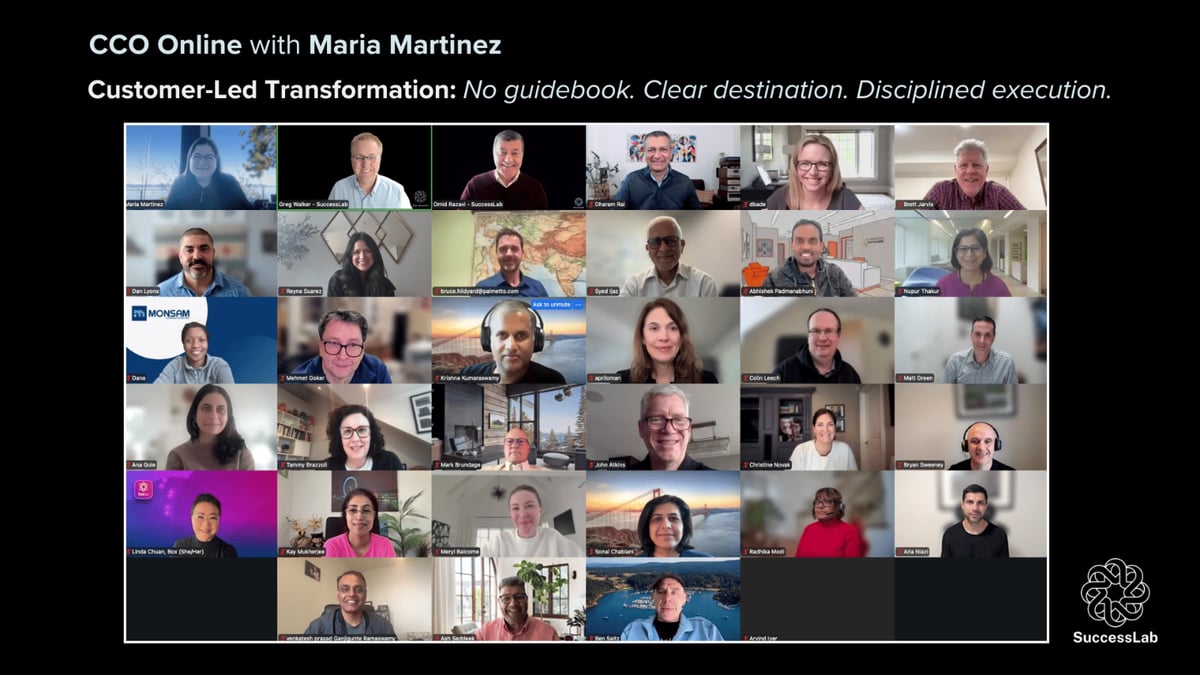
# CCO Online
From Customers for Life to Enterprise Transformation at Scale
May 4, 2026Opening Remarks
Good morning, everyone. Welcome to CCO Online. Today, I am honored to welcome Maria Martinez.
Maria is one of the most influential customer leaders in enterprise technology. She has held senior roles at Microsoft, Salesforce, and Cisco. More importantly, she helped shape how technology companies organize around customers.
At Salesforce, Maria helped codify Customer Success as a discipline. She led the Customers for Life organization across success, support, renewals, services, and education. She built renewals into a disciplined business function at a time when recurring revenue was becoming central to Salesforce’s growth model.
She also helped establish early warning systems to identify customer risk and protect retention, and helped shape tiered success offerings that aligned service levels, support models, education, and value delivery with customer needs.
Many practices we now take for granted in Customer Success trace back to that era: onboarding as a formal motion, adoption as a managed outcome, renewals as a discipline, tiered success plans, executive and quarterly business reviews, and customer outcomes that are designed, measured, and managed.
Later, at Cisco, Maria took customer leadership to a broader enterprise level. Cisco was transforming from a hardware-led business to a software-led, subscription-based, recurring-revenue model. Maria joined as Chief Customer Experience Officer and later became Chief Operating Officer. Her remit expanded across customer experience, services, renewals, supply chain, security and trust, IT, and enterprise transformation.
Today, Maria serves on several major boards, including Bank of America, McKesson, Tyson Foods, Fiddler AI, and JumpCloud. She brings a rare combination of technical depth, operating discipline, customer focus, and governance experience in this new AI era.
For the SuccessLab community, Maria’s career is a powerful reminder that Customer Success, Support, and Services can become strategic leadership platforms — not just functions or departments, but engines of growth, transformation, and enterprise value.
On Leadership Through Transformation
Omid: You started in engineering and then moved through services, Customer Success, enterprise operations, and now board leadership. As you reflect on those chapters, what mindset or leadership traits have served you best?
“Leadership is tested to the maximum during transformation.”
Maria: I have been fortunate to have a career full of opportunities, and I have been in the middle of many major technology transformations. Transformation is where leadership is tested the most. When you are driving something new, you need the core leadership traits, but they get tested at a much higher level.
“Leaders need soul, mind, and heart.”
I think about leadership through three simple pillars: soul, mind, and heart. Soul is vision and passion. Mind is structure, goals, simplicity, and clarity. Heart is about people, teams, collaboration, inclusion, and empathy. At the end of the day, resilience matters most. You have to keep going, especially through difficult times.
On Starting When There Is No Playbook
You have said that in transformation, there is often no guidebook. When the path is not clear, where do you start?
“When there is no playbook, you start with the end goal.”
Traditional managers often have a playbook. You get a task, a project, or a function, and you know how to approach it. But when you are driving something truly transformative, there is no playbook. You start with the end goal. You define the mission and the destination, and then you figure it out along the way.
I often think about President Kennedy saying we would go to the moon. There was no detailed playbook at that moment, but there was a clear mission and a clear end goal. That is what aligns people and gives them the energy to figure out the path.
On Customers as the Unifying Force
You have said that customers show the destination. How do you listen to customers at enterprise scale?
“Customers are the thing that unifies everything.”
For me, the customer is the unifying force. When teams get stuck in internal debates, the customer lens helps bring alignment.
“Being customer-centric does not mean doing everything the customer asks.”
That is an important distinction. You always listen to the customer. You understand the need. You distill the feedback. But sometimes you need to push back. Sometimes you need to deliver a future that is even better than what the customer requested.
Listening has to happen through many mechanisms: direct customer conversations, executive engagement, surveys, focus groups, formal feedback loops, product telemetry, and transactional feedback. As a leader, I have always wanted to ensure a meaningful percentage of my calendar is spent directly with customers.
On Turning Customer Feedback into Operating Change
Can you share an example where a customer need became clear, but the company had to change internally to meet that need?
At Cisco, we built technology to support customers at scale. That direction came directly from customers. We brought customers into labs, ran focus groups, and created formal feedback loops. The customer input helped shape the product's direction and the operating model around it.
The key is that customer knowledge should guide the future. But again, that does not mean simply reacting to every request. It means understanding what the customer is really trying to accomplish and building around that.
On Great Execution
When the goal is better customer outcomes, and your team is aligned around that goal, what does great execution look like?
“Great execution starts with goals.”
Great execution starts with goals. At Salesforce, one of the frameworks I valued was V2MOM: vision, values, methods, obstacles, and measures. There are other frameworks, but the point is the same. You need a clear vision, concrete goals, measurable outcomes, and operating discipline.
Execution is not just about achieving the goal. It is also about the how. You want to create a framework that allows the team to execute consistently over time.
On Customer Signals and Operating Models
We now have more customer signals than ever. What signals tell you that the operating model is working, and what signals show that it needs adjustment?
We have more signals than before, but we still don't have enough. You need to instrument the product, every touchpoint, and the customer journey to gather feedback and understand what is happening.
I think about customer signals in three categories. First, relationship feedback: NPS, brand perception, executive sentiment, and overall customer experience. Second, product feedback: telemetry, usage, adoption, and customer interactions. Third, transactional feedback: what happens every time the customer touches your company. All three matter.
On the Role of the CCO in the C-Suite
The Chief Customer Officer is still a relatively newer role compared with other C-suite functions. Once customer leadership has a seat at the executive table, how do you create accountability across Product, Sales, Finance, Marketing, and other functions?
It is very important for the customer to be represented in the executive team. The exact structure can vary by company, but someone needs to sit at the table as the customer advocate.
At the same time, the role has to be concrete. It cannot only be about customer sentiment or customer metrics. It also has to connect to the company's financial impact. In a recurring revenue model, that often means revenue retention, expansion, adoption, and attrition. At the C-suite level, you have to connect the customer agenda to the business agenda.
On Earning Resources by Owning Outcomes
Many CS and customer leaders ask how they can get more resources. What advice do you have?
“Resources follow when everyone is convinced the outcome matters.”
Do not lead with the resource ask. Start with what you are trying to achieve, why it matters to the company, and what business outcome you are committing to deliver.
At Salesforce, attrition was a major issue. We were able to show that reducing attrition would have a direct financial impact. When you can say, “I am going to help move this business outcome, and I am personally accountable for it,” the resource conversation becomes much easier.
At Cisco, the challenge was different. We were helping move value from hardware into software and recurring revenue. Again, the conversation was about how the customer organization could help the company achieve a strategic and financial goal. Resources follow credibility, and credibility comes from connecting your work to company outcomes.
On Avoiding the “Department of Complaints”
One CCO once told me, “Sometimes I feel like I am becoming the department of complaints.” How should customer leaders work more effectively with Product and Engineering?
“You cannot just bring complaints. You need to bring data.”
The customer organization needs a strong operating model with Product and Engineering. But you cannot just bring complaints. You need to bring data.
Product teams want to build great products. They want to know how customers use the product, where they struggle, and what changes will improve quality and outcomes. For example, you can show that a certain percentage of support calls are tied to one product issue. That becomes a data-driven conversation, not a complaint.
I also believe in having dedicated Product or Engineering capacity connected to customer issues. At Salesforce, we negotiated a certain percentage of engineering points to be dedicated to issues coming from customer data. The key is to create a consistent operating model with Engineering, share customer data regularly, and promote the impact of their work in supporting customers.
On Partner Success as Part of Customer Success
At both Salesforce and Cisco, partners played a major role in customer delivery. How do you think about partner success?
Partner success is part of the customer operating model.
For technology product companies, partner success is one of the hardest and most important parts of the job. Some companies depend heavily on partners. At Cisco, more than 90% of sales went through partners. At Salesforce, partners were critical for implementations and customer success.
The company has to be clear about why its own customer organization exists and where partners fit. As the product company, you often need to lead the first implementations, maintain the closest connection to Engineering, define standards, and build the early practices. Partners extend scale, local presence, and delivery capacity.
Every company needs its own model, but the key is to define what the company owns, what partners own, and how the two work together to create customer success.
On Leading Through Change and AI
AI, economic uncertainty, and new operating models are forcing leaders to manage significant change. What leadership practices matter most in this environment?
“AI is changing things at a speed we have never seen before.”
AI is changing things at a speed we have never seen before. I have seen major transformations before: cellular, cloud, subscription models. But AI is accelerating change in a completely different way.
The core leadership traits still matter: vision, clarity, goals, empathy, and the ability to bring people along. But they matter even more now. Change is hard for people. Roles are changing. New roles are being created. People are learning how to work with AI, how to manage agents, and how to adapt their skills.
Leaders need to be sensitive to the human side of change. They need to create clarity, communicate often, and give people space to adapt.
On Restoring Focus During Change
When change gets hard and people get distracted, how do you restore focus and momentum?
You come back to the basics of leadership. You need a strong vision. You need clear goals. You need simplicity and clarity. You need empathy and connection with the team. People need to understand what matters most and what they are being asked to do.
I created a manager guidebook many years ago, and while the emphasis has changed over time, the core elements have not changed that much. Great leadership still comes back to clarity, communication, and connection with people.
On What Leaders Underestimate About Transformation
What do leaders often underestimate about sustaining transformation?
They underestimate the emotional side of change. When you change someone’s job or operating environment, it takes time for that person to process and adapt. Leaders often think transformation can happen faster than it does.
They also underestimate communication. You cannot communicate something once and expect people to absorb it. You need to communicate the vision, goals, and direction again and again. People need consistency. They need to see that the organization is still moving toward the same destination.
On the Boardroom and the Customer
From your board seat, what do you wish leaders did differently when they talk about customers and transformation?
“Boards need to spend more time talking about customers.”
I wish they talked about customers more. Boards spend a lot of time on financials, operations, risk, and strategy. But sometimes the customer does not get enough time.
I often ask, "What are we hearing from customers?" Can we bring customers into the boardroom? Can we hear directly from them? When it happens, it is very powerful.
On How Boards Are Thinking About AI
AI is now a major boardroom topic. How has the conversation changed over the past year?
AI is now one of the top topics for boards. It touches everything. There is the people side: training, roles, tools, and productivity. There is the risk side: cybersecurity, trust, governance, and responsible use. There is also the strategic side: how AI can create new business models, new innovations, and new ways of operating.
Boards are trying to sort through all of this. The area I push the most is strategic AI. How do we use AI to transform the company, not just make existing work more efficient? That is where the biggest opportunity sits.
Audience Q&A Highlights
How Much Time Should CCOs Spend with Customers
For a CCO, how do you decide which customers deserve your personal time and attention?
Every leader has to choose the right amount, but I usually aimed to spend about 20% of my time with customers.
The specific metrics matter less than choosing the few metrics that matter most for your business. Do not pick too many. Pick the top two or three that truly matter, align the executive team around them, and then spend serious time understanding and improving them.
At Salesforce, attrition was the top metric. We spent a lot of time analyzing every dollar that was leaving the company. Some issues were adoption-related. Others were pricing, credit cards, contracts, or process problems. The key is to pick the right metrics and go deep enough to understand what is really driving them.
Are CSMs Becoming More Technical?
Are CSM roles becoming more technical? Is that where the market is heading?
Every company needs a clear operating model for customer-facing roles. The right model depends on the company, the product, the customer segment, and the go-to-market motion. At a high level, I see a move toward more technical CSMs.
To add real value, customer-facing teams need to answer more questions directly and understand the product more deeply. But the bigger trend is not just making the CSM more technical. It is surrounding customer-facing people with better tools, telemetry, education, assets, and resources.
The future is about equipping customer-facing teams with data and technology to be more effective.
Building Signal Hierarchy for AI-Native Products
For AI-native products, there are more signals and more data than ever. How should founders and CS leaders decide which signals matter most?
I am very excited about the idea of company-wide alignment around value use cases. Take your product and define the few value use cases that matter most to customers. Then align Engineering, Marketing, Sales, and Customer Success around those use cases.
This creates a shared language. It also helps you decide where to prioritize telemetry and signals. You are not just measuring everything. You are measuring the things connected to customer value.
I haven't seen many companies do this perfectly yet, but it is an important direction.
Customer Friction and Healthy Pushback
How do you distinguish between what customers ask for and the deeper friction points they are experiencing? How do you push back in a healthy way?
Customers often describe symptoms rather than the underlying problem. That is why data and AI are so important. They help you observe behavior, identify patterns, and understand friction in a different way.
You can then go back to the customer and say, “I hear what you are telling us, but here is what we are also seeing in the data.”
The best customer executives are often the ones who push the customer the hardest — not in a negative way, but in a way that helps the customer get to a better outcome. They do not just take customer feedback and push it internally. They distill it, interpret it, and bring evidence. That is how customer leadership becomes strategic.
Closing Reflection
Customer leadership is changing.
It is no longer enough to operate a function called Customer Success, Support, Services, or Customer Experience. The real work is helping the company organize around customer value.
That requires a broader leadership model: vision, operating discipline, financial fluency, customer evidence, product partnership, partner strategy, and the ability to lead people through change.
“AI raises the bar for customer leaders: more data-driven, more cross-functional, more technically fluent, and more board-relevant.”
AI will only raise the bar. As customer signals multiply and business models evolve, customer leaders will need to become more data-driven, more cross-functional, more technically fluent, and more board-relevant.
Maria’s career reminds us that customer leadership is not a function to manage. It is a strategic platform for aligning the company, accelerating transformation, and creating enterprise value.
Thank you to the SuccessLab community and our CCO Online participants for joining, engaging, and asking thoughtful questions. Your participation made the conversation richer.
On behalf of SuccessLab and CCO Online, thank you, Maria, for your time, wisdom, and generosity.
The next era of customer leadership will belong to those who can turn customer value into an operating discipline.
This article is part of CCO Perspectives. Subscribe for future reflections, and join the SuccessLab community at community.successlab.us to view the session recording and continue the conversation.
Like
Comments (0)
Popular

Dive in
Related
Blog
Maria Martinez: Architect of the Modern Customer Success Discipline
By Omid Razavi • Apr 6th, 2026 • Views 2
Blog
It’s Time to End the Confusion: Split Customer Success into Product Success and Account Management
Mar 9th, 2025 • Views 1
Blog
Listen, Predict, Compose, Act – The AI Superpowers Reinventing Customer Success
Apr 18th, 2025 • Views 0
Blog
Maria Martinez: Architect of the Modern Customer Success Discipline
By Omid Razavi • Apr 6th, 2026 • Views 2
Blog
Listen, Predict, Compose, Act – The AI Superpowers Reinventing Customer Success
Apr 18th, 2025 • Views 0
Blog
It’s Time to End the Confusion: Split Customer Success into Product Success and Account Management
Mar 9th, 2025 • Views 1