

Inside Salesforce Support: How Agentforce Is Redefining Customer Experience
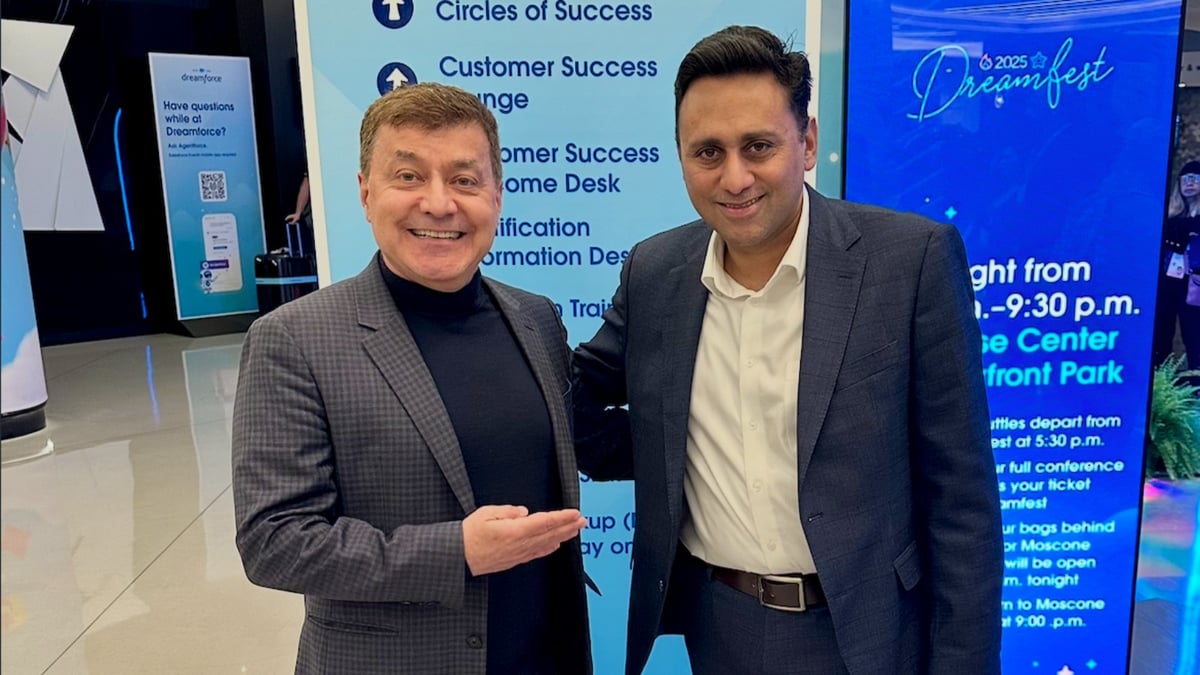
A Conversation with Sanjeev Balakrishnan, EVP of Customer Success at Salesforce — by Omid Razavi, Founder of SuccessLab
November 20, 2025Every year at Dreamforce, I make it a point to catch up with Sanjeev Balakrishnan, Executive Vice President of Customer Success at Salesforce. It has become something of a tradition, and always a highlight, to learn firsthand from one of the most respected voices in our industry about how Salesforce continues to evolve its support organization. This year too, Sanjeev was generous with his time amid a packed schedule of customer and partner meetings, offering candid insights into how his team became Customer Zero for Agentforce, Salesforce’s AI platform for customer and employee experience, and how it’s redefining the future of service.
Starting at the Front Door
Omid: Sanjeev, every support leader I meet is wrestling with the same challenge — customer expectations keep rising, and boards want clear proof of AI’s impact. You’ve been at the center of this shift inside Salesforce. You were literally Customer Zero for Agentforce. How did you decide where to begin?
Sanjeev: That was the big question — where do we start? Many companies begin with a small back-end use case to test the waters. We went straight to where customers actually feel the friction — the front door — with help.salesforce.com, our public Help portal. We piloted Agentforce with a limited audience, scaled it quickly, and made the process completely transparent. If you visit the site today, you’ll see a live scorecard that updates in real time.
Omid: That’s bold, starting customer-facing rather than behind the scenes. How did you define success for that pilot?
Sanjeev: Our goal was never to add more effort for the customer. They remain in control, supported seamlessly by both digital agents and human experts working together to assist as needed. We also enabled multilingual support — customers can interact in any language, and our team receives it in English. Voice capabilities are next.
Omid: So you truly built a “customer-in-the-loop” model. I love that. You mentioned the live scorecard — what metrics are you tracking?
Sanjeev: We track the number of conversations, resolution rate, customer-confirmed resolution, handoffs, and abandon rate. We publish these results so customers can see how well Agentforce performs, not just internally, but publicly as well. It keeps us accountable and builds trust.
Learning by Doing
Omid: When you rolled out Agentforce, what surprised you the most — something you only discovered after going live?
Sanjeev: Honestly, we learned how much human sensitivity still matters, even in AI. Early on, we focused heavily on the technical side, ensuring our content and Data Cloud grounding were solid. But the softer side took time. We had to train in tone, empathy, and politeness —those subtle nuances that make customers feel genuinely understood.
Omid: That’s a great insight — we’ve all seen bots that sound factual but tone-deaf. How did your team internalize that?
Sanjeev: We created new roles — conversational designers — people who design how humans and AI talk. It’s not the same as prompt engineering; it’s about interaction flow and tone. We also incentivize internal teams to improve “agent efficacy,” similar to KCS gamification for knowledge sharing.
Omid: Brilliant! An evolution of Knowledge-Centered Service (KCS®) for the AI era. You’re not just maintaining knowledge; you’re cultivating intelligence, rewarding teams for making the agent smarter with every interaction.
The Workforce Transformation
Omid: Every transformation has a people side. AI brings both excitement and anxiety. How did you manage that internally?
Sanjeev: The biggest factor was transparency. When we launched Agentforce, my team became Customer Zero before the product even went GA. We immediately began training everyone on Data Cloud and Agentforce. We raised the bar — if you work in my organization, those are now foundational skills.
We also launched Career Connect, a portal where every employee lists their skills and aspirations. Before we hire externally, we always check internally. The goal is to rebalance the workforce, not reduce it. If someone’s workload declines due to automation, we help them upskill or transition into more proactive roles.
Omid: That’s a powerful model — internal mobility before external hiring. How are frontline roles evolving as automation takes hold?
Sanjeev: For individual contributors, it’s about breadth. We used to have one product, one skill per person. Now, everyone is expected to hold primary, secondary, and tertiary skills. As simpler case volumes decline, you need flexibility to handle the more complex issues that remain.
Omid: And what about support managers or supervisors — how is their day-to-day changing?
Sanjeev: The biggest shifts are still ahead. I imagine supervisors moving beyond managing just human queues. They’ll oversee blended ecosystems of digital and human agents, orchestrating both in real time. Think of a command center where supervisors watch live sentiment across every interaction, not after the fact. Still, as it unfolds, they can instantly redirect, intervene, or guide when something veers off course.
Omid: So, in the future, supervisors will essentially be leading two teams at once, digital agents and human agents, all operating in one unified workspace.
Sanjeev: Exactly. That’s the direction I see. Traditional QA becomes continuous and proactive. Instead of analyzing sentiment after a case closes, supervisors will anticipate issues mid-conversation. When digital agents struggle or sentiment dips, a human can jump in immediately. It becomes a live, adaptive system — everything happening in sync, in the moment.
Their jobs are evolving the most. Supervisors aren’t just managing human queues anymore; they now oversee digital and human workloads together. They monitor live sentiment dashboards, observe ongoing conversations, and step in when needed to guide or reassign interactions in real time. The work has become synchronous, not asynchronous — everything happens in the moment.
Omid: So supervisors are effectively managing two teams: digital agents and human agents, side by side in the same command center.
Sanjeev: Exactly. We call it the Command Center. In traditional QA, you’d analyze sentiment after a case closed. Now we can see it as the conversation unfolds. If sentiment dips or an interaction goes off track, a human can step in immediately.
Driving Change and Adoption
Omid: That’s transformative, but also intense. How did you get people comfortable with this level of real-time responsibility?
Sanjeev: Change management has been huge. You can’t just announce AI and expect everyone to cheer. We gave people time, training, and space to learn. We acknowledged their concerns — people hear “AI will take your job” and freeze. We flipped the message: AI will change your job, and we’ll help you grow with it.
Omid: That’s a thoughtful approach. How did you gauge when the AI was mature enough to take on more?
Sanjeev: You have to nurture it like a new hire. Early on, we set guardrails, for example, “don’t discuss competitors.” But that sometimes blocked legitimate questions, so we had to adjust quickly. We learned that Agentforce improves rapidly, but you still need human oversight and continuous feedback loops.
Omid: So, a balance between safety and agility.
Sanjeev: Exactly. You can’t over-engineer AI on day one. Start with the right intent, keep the loop between humans and AI tight, and evolve together.
Omid: How did your team respond once they started seeing results?
Sanjeev: Once people saw Agentforce saving time and simplifying cases, confidence grew quickly. We started to hear comments like, “This lets me focus on real customer problems.” That’s when you know the change is working — when the technology fades into the background and people start seeing the value in their day-to-day work.
Rolling Out AI in Stages
Omid: For support leaders who are just beginning their AI journey, where should they start?
Sanjeev: Don’t wait to have it all figured out. Start small, start real. Pick your top five case drivers — the issues that account for 20–25% of your total volume. It could be password resets, token generation, or policy renewals. Automate those first.
If your customer traffic comes through email, use AI to triage and summarize incoming messages. If it’s through a portal, start there. What matters most is that customers can always reach a human easily.
Omid: So it’s less about complexity and more about going after what customers see and feel every day.
Sanjeev: Exactly. Focus on volume and visibility, not on solving everything at once. Give customers confidence by ensuring human support is always within easy reach when they need it. When customers know that seamless handoff is possible, they trust your AI faster and engage with it more confidently.
Omid: That’s such a practical roadmap; visible impact, quick wins, and a human safety net.
Sanjeev: Yes, and each use case teaches you something new — about your content, your processes, and your customers. Those learnings compound, and that’s how transformation scales.
Creating Value Beyond Resolution
Omid: Many support leaders are now being asked to show incremental value — not just resolve cases, but identify opportunities for growth and expansion. How is Salesforce approaching that?
Sanjeev: We’re experimenting thoughtfully. Our goal isn’t to turn support into sales, but rather to identify authentic opportunities where a customer could benefit from a feature or capability they don’t currently have. When Agentforce or a support engineer spots such a moment, we surface it as a lead for Sales.
It’s about helping the customer, not pitching to them. The best time to create value is after you’ve earned trust through resolution — when you’ve demonstrated understanding and reliability.
Omid: That’s a powerful idea — outcome-first, revenue-second. I imagine AI plays a growing role in uncovering those opportunities earlier.
Sanjeev: Exactly. Through pattern recognition across cases and interactions, AI can detect signals that humans might overlook — recurring needs, gaps in product usage, or missed adoption opportunities. It’s still early, but the potential is substantial. Over time, we expect this to help customers get more value faster and help us deepen relationships in a way that feels natural and authentic.
Looking Ahead
Omid: If you had to summarize Salesforce’s Agentforce journey so far in one sentence, what would it be?
Sanjeev: Start where your customers feel it, publish your progress, and train your people relentlessly.
Omid: That captures it perfectly — simple, direct, and human. I know Dreamforce weeks are intense, so one last question: what’s next for Agentforce?
Sanjeev: Voice. It’s the next natural frontier. We’re building voice-based Agentforce capabilities, starting with the simpler, high-volume flows and then blending them into the same digital–human handoff model that’s already working so well. The vision is a seamless, 24/7 customer experience — available in any language, across any channel, and smart enough to move effortlessly between voice, chat, and human support when needed.
Omid: A truly connected experience — intelligent, multilingual, and always on. That’s where customer support is headed.
Thank You, Sanjeev
A heartfelt thank you to Sanjeev Balakrishnan for taking the time — yet again — during an intense Dreamforce week to share such candid, actionable insights. Conversations with Sanjeev always leave me with a deeper appreciation for what it truly takes to transform a global support organization, especially one operating at Salesforce’s scale.
What I value most is his combination of clarity, humility, and practicality. He never speaks about AI as hype or inevitability; he frames it as a human transformation, a systems transformation, and a leadership transformation. And every year, I walk away with ideas I immediately bring back to the SuccessLab community.
My Reflections
This conversation reaffirmed several themes that are shaping the future of Customer Service and Support — themes that matter deeply to the leaders in our CSS community:
1. Start where customers feel the effort.
Beginning at the Help front door wasn’t just bold; it was customer-centric in the purest sense. It underscores a simple truth: transformation should begin where customers actually experience the journey, not where it’s easiest for the organization.
2. Transparency is a differentiator.
Publishing a real-time AI scorecard is still rare in our industry. But it’s the kind of openness that builds trust and invites customers into the process. When customers can see performance as it happens, not only when it’s polished, confidence grows and partnerships strengthen.
3. AI success is a people strategy.
Upskilling, career mobility, and human-in-the-loop orchestration came up repeatedly. Salesforce isn’t just modernizing support; it’s modernizing the support profession. The future isn’t only about better automation — it’s about better opportunities for people.
4. Supervisors and frontline experts are entering a new era.
Real-time orchestration of digital and human agents is becoming the new normal. The service environment is shifting toward something more responsive, more empathetic, and far more data-informed than what most organizations are used to.
5. Co-creation remains the north star.
Whether it’s evolving Agentforce, refining guardrails, or creating new roles like conversational designers, the pattern is clear: innovation moves faster, and sticks longer, when it’s built with your people and your customers.
For me personally, this conversation reinforces why communities like SuccessLab exist: to share what we’re learning, to humanize this transformation, and to help leaders move forward with clarity and confidence.
If you’d like to continue this dialogue, you’re warmly invited to:
- Subscribe to CCO Perspectives, my newsletter on how AI and leadership are reshaping customer service, support and success
- Join our community at: community.successlab.us
I look forward to learning how you and your teams are shaping the next chapter of customer leadership.
Important Note:
This article reflects my personal insights and reflections from my conversation with Sanjeev Balakrishnan. It should not be interpreted as an endorsement or official position of Salesforce.
Like
Comments (0)
Popular

Dive in
Related
Blog
Scaling Success: How Salesforce is Transforming Customer Support with Empathy and AI
Sep 24th, 2024 • Views 1
Blog
Scaling Success: How Salesforce is Transforming Customer Support with Empathy and AI
Sep 24th, 2024 • Views 1