

Customer Success: Expendable or Essential? Part 2
Omid Razavi
April 8, 2024Customer Success (CS) ensures customers achieve their desired outcomes with your products or services, delivering great experiences and proactively enhancing customer value. It encompasses strategic planning, proactive engagement, and internal advocacy to align company efforts toward customer goals. Given the complexity and scope of these activities, it's only possible to achieve these effectively with a dedicated CS team.
In this article, we recognize the unique value proposition that CS teams bring and explain why this team is essential for delivering a seamless customer journey, fostering enduring relationships, and ultimately driving successful outcomes.
Foundational Elements for Customer Success
A robust Customer Success program is built upon three fundamental elements:
- Collaborative Approach - CS must collaborate with almost every function in the organization, leveraging diverse expertise and perspectives. This collaborative effort enhances the overall experiences and drives aligned execution across the organization.
- Data-Driven Decision-Making - Central to CS, various data sources' insights are relied on to guide proactive engagement and decision-making. A data-driven approach becomes crucial as CS teams evolve from high-touch models, particularly after surpassing $20M in ARR. Utilizing data from CRM, CS platforms, support, marketing, financial systems, and external sources empowers CS to detect patterns, foresee customer needs, and tailor experiences, driving informed customer engagement. This strategic use of comprehensive data sets CS apart from other functions.
- End-to-End Customer Centricity - CS must remain dedicated to championing the voice of the customer (VoC) throughout the entire lifecycle, from onboarding (or pre-boarding during trials) to renewal and beyond. This relentless focus on end-to-end customer centricity distinguishes CS from other departments by maintaining continuous and meaningful interactions across all customer lifecycle stages.
These elements collectively enable CS teams to be indispensable in delivering seamless customer journeys, building lasting relationships, and driving favorable outcomes.
Customer Success and Sales
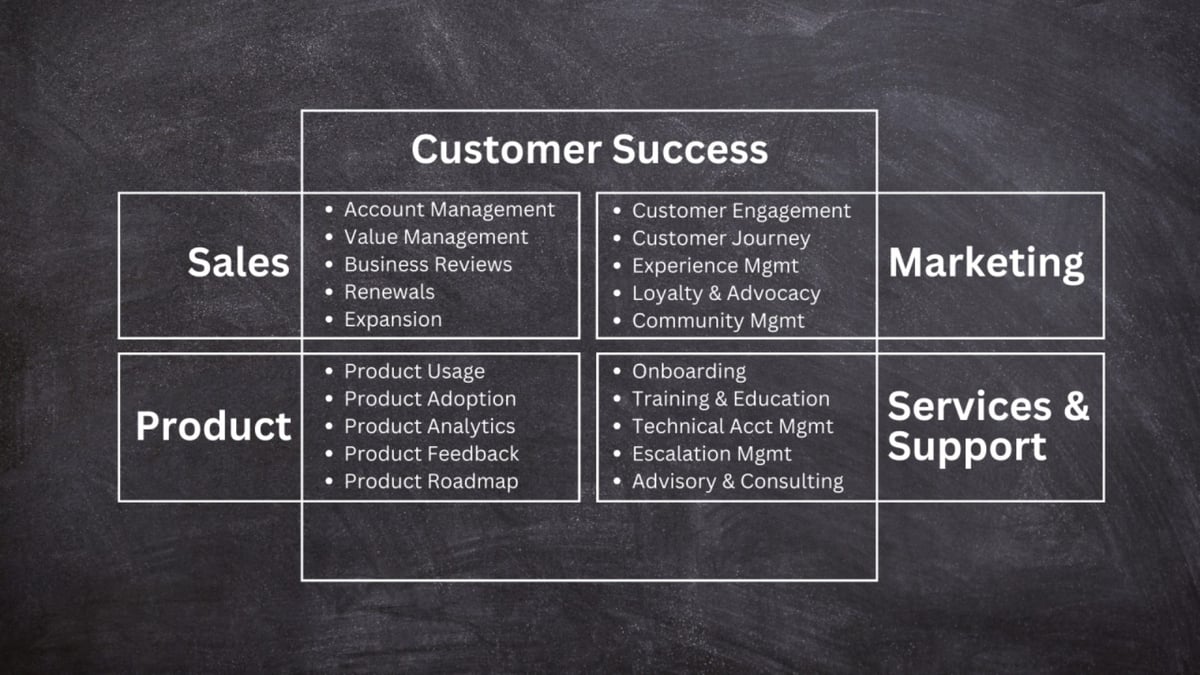
The industry has generally recognized the vital need for collaboration between Sales and Customer Success, including the challenges and considerations around reporting structures. Here, we focus on the critical collaboration between these teams, particularly in areas where CS should lead, working alongside Sales to drive customer retention and growth.
Account Management
Customer Success is highly effective in account management, prioritizing long-term customer outcomes over the short-term objectives that Sales typically focuses on. This strategic difference places CS in a prime position to cultivate and enhance relationships, meeting ongoing customer needs and boosting retention and loyalty. Yet, a collaborative relationship between CS and Sales is essential, as it combines their strengths to offer a cohesive, customer-first strategy.
Value Management
For Customer Success, value management is about turning potential benefits into ongoing, realized value, contrasting with Sales' focus on prospective gains to win customers. Post-sale, CS plays a crucial role in ensuring customers continuously gain value from their investment through effective implementation and adoption, guiding them to tangible outcomes. This shift from potential ROI to actual recurring value underscores the enduring impact of CS.
Executive Business Reviews
Customer Success is ideally suited to lead Executive Business Reviews due to their in-depth knowledge of customer interactions, product usage, outcomes, and challenges. This positions CS to conduct reviews that foster strategic alignment between the customer's business objectives and the products or services, promoting mutual success and loyalty. Engaging in this manner, often in collaboration with Sales, ensures meaningful and productive customer relationships.
Renewal Management
Placing Renewal Managers (RMs), who are specialized Customer Success Managers (CSMs), under the Chief Customer Officer (CCO) rather than Sales enhances customer retention and leads to timely and advantageous renewals. This setup utilizes insights from customer engagement and usage to negotiate renewals effectively. Aligning RMs with the CCO underscores the commitment to maintaining long-term customer relationships, often resulting in timely renewals and mutually favorable terms.
Expansion, Upsell and Cross-Sell
Customer Success teams are on par with Sales in driving expansions, upsells, and cross-sells, leveraging their deep insight into customer needs. With proper training in identifying opportunities and capitalizing on ongoing interactions, they can drive expansion initiatives more cost-efficiently than Account Executives (AE). This skill allows CS to recommend beneficial solutions, enhancing customer trust and stimulating growth.
Customer Success and Marketing
In many SaaS companies, the synergy between Customer Success and Marketing is often an untapped strength. Yet, some forward-thinking firms integrate CS with Sales and Marketing into a cohesive go-to-market (GTM) team. Marketing's prowess in generating brand awareness pairs well with CS's in-depth customer insights, driving customer engagement and loyalty through a united approach that effectively leverages Marketing's strategies and tools.
Customer Engagement and Re-engagement
Customer Success is well suited for customer engagement and re-engagement, leveraging in-depth knowledge of customer histories and preferences. This personal understanding enables Customer Success to craft interactions that resonate more deeply than Marketing's broader campaigns, often perceived merely as lead generation for Sales. Customers who recognize the personalized touch are more likely to engage with CS initiatives, with a higher likelihood of positive response.
Customer Journey and Lifecycle Management
Customer Success offers a detailed, evolving view of the customer journey enriched by client interactions to grasp their changing needs and aspirations. Unlike Marketing, which typically focuses on the journey up to the sale, CS creates more nuanced maps that account for customer usage, maturity, segments, and industries. This adaptable mapping approach aids in effectively managing long-term customer relationships.
Customer Experience Management
Customer Success offers a unique approach to managing customer experiences beyond Marketing's broad brand strategies across all channels and media. CS ensures meaningful product or service interactions, focusing on proactive outreach, personalized guidance, and real-time assistance. Additionally, CS actively solicits and incorporates customer feedback into its management approach, continuously refining and optimizing the customer experience based on direct input from users.
Customer Loyalty and Advocacy
Customer Success is instrumental in fostering customer loyalty and advocacy by deepening relationships and delivering consistent value. Unlike Marketing, which initiates brand engagement, Customer Success ensures long-term commitment by surpassing expectations, solving problems, and providing tangible benefits. This dedication turns satisfied customers into brand champions who share their positive experiences through referrals, reviews, and presentations facilitated by Marketing.
Community Management
Customer Success excels in digital community management by nurturing genuine connections and fostering meaningful customer interactions. Unlike Marketing, which focuses on community building for promotional efforts, CS engages community members around shared experiences and interests in the product or service. CS enhances brand loyalty and customer feedback within these digital communities by promoting peer-to-peer engagement and group collaboration.
Customer Success and the Product Team
The collaboration between Product Management and Customer Success is vital for a product's success, ensuring it meets customer needs and delivers value. They work together in areas like analyzing product usage, boosting product adoption, reviewing product analytics, gathering product feedback, and aligning on the product roadmap. Their partnership in these areas helps in making data-informed decisions that enhance user experience and value:
- Product Usage—Together, they analyze user interaction data to understand how features are used and identify areas for improvement.
- Product Adoption—Jointly develop strategies to increase user and feature adoption, including educational content and in-app guidance.
- Product Analytics—Jointly review analytics to gauge product performance and user satisfaction, influencing future development priorities.
- Product Feedback—Collect customer feedback to inform product quality and usability.
- Product Roadmap—Collaborate on the product roadmap, incorporating customer feedback and usage data to prioritize future features and updates.
Customer Success and Services & Support
In many organizations, Services & Support and Customer Success often report to the same executive, such as the SVP of Customer Experience or the Chief Customer Officer, making these functions specialized branches of the broader Customer Organization. While Services & Support handles technical aspects, user education, and issue resolution, CS focuses on boosting product adoption, ongoing usage, and value. Their collaboration ensures a seamless experience from onboarding to ongoing engagement, emphasizing a cohesive approach to delivering customer value and support.
Core Customer Success Practices
Customer Success teams are the backbone of any organization's efforts to secure customer loyalty and growth. They function as strategic partners in propelling success, fostering enduring relationships, and maximizing customer value. Here are ten core practices through which CS teams can demonstrate their unparalleled capabilities to both customers and the organization:
- Success Planning—CS teams collaborate with clients to develop comprehensive success plans outlining clear goals, milestones, and success metrics. These plans, which are different from account plans by Sales, provide a roadmap for achieving desired outcomes and aligning strategies with client expectations.
- Account Health Monitoring—CS teams utilize advanced monitoring tools and metrics to assess customer accounts' health continuously. They can identify potential issues early by tracking indicators such as usage patterns, engagement levels, and satisfaction scores and take preventive action to mitigate churn.
- Data-Driven Decisions—CS teams leverage data analytics and insights to inform decision-making processes. By analyzing customer data, including usage trends, support interactions, engagements, and feedback, they gain valuable insights to drive strategic initiatives and optimize customer success efforts.
- Churn Prevention and Risk Analysis—CS teams employ a proactive strategy to identify customers at risk of downgrading their subscriptions or discontinuing their relationship with the organization. The goal is to intervene before customers decide to churn, thereby retaining their business and preserving revenue. Churn prevention involves various tactics and techniques, such as predictive analytics and machine learning algorithms, to identify signs of potential churn and take corrective actions to mitigate the risk.
- Long-Term Retention Management—CS teams prioritize building long-term relationships with clients based on trust and mutual success. They foster open communication, deliver on promises, and consistently exceed expectations to establish loyalty and advocacy beyond individual transactions.
- Success Story Creation—The CS team's success story creation involves capturing and sharing the experiences of satisfied customers who have achieved notable results or overcome challenges with your product or service. These success stories, case studies, or testimonials are powerful marketing tools for your organization, showcasing your offerings' real-world benefits and value.
- Collaborative Teamwork—CS teams collaborate closely with cross-functional teams, including Sales, Marketing, Product, Support, Human Resources (HR), and Finance. CS delivers a seamless and cohesive customer and employee experience across all touchpoints by sharing insights, aligning strategies, and coordinating efforts.
- Customer Success Technologies—CS teams rely on diverse technology tools to drive success, including CRM systems, customer data analytics platforms, communication tools, and automation software. These tools, increasingly incorporating Artificial Intelligence capabilities, serve to streamline operations, track customer interactions, and personalize engagements at scale. CS teams use these technologies to enhance efficiency and effectiveness in delivering customer value.
- Cohort Analysis and Lifetime Value—For CS teams, conducting cohort analysis and understanding the lifetime value of customers are pivotal activities. Cohort analysis involves grouping customers based on similar characteristics or behaviors and tracking their performance over time. By examining cohorts, CS teams can identify trends, patterns, and shifts in behavior that provide valuable insights into customer behavior and satisfaction levels. Moreover, integrating lifetime value (LTV) analysis into cohort analysis enhances the depth of understanding. LTV helps quantify the revenue a customer is expected to generate over their entire relationship with the company. By combining cohort analysis with LTV calculations, CS teams can better prioritize their efforts, focusing on customer segments with the highest potential for long-term value.
- Performance Benchmarking—For CS teams, performance benchmarking serves as a valuable service to customers and the organization by clearly understanding how their performance compares to industry standards and best practices. For customers, benchmarking allows them to gauge their progress and effectiveness in achieving desired outcomes compared to their peers or competitors. It helps them identify areas of strength and areas needing improvement, enabling them to make informed decisions and adjust their strategies. Performance benchmarking is equally essential for the organization as it enables them to assess the effectiveness of the CS initiatives and strategies. By benchmarking key metrics such as customer retention rates, satisfaction scores, and product adoption rates, the organization can identify areas where they excel and need to improve. This insight allows them to refine their processes, allocate resources more effectively, and prioritize initiatives that impact customer success and satisfaction the most.
Summary
In Part 2, we discuss the critical role of Customer Success in enhancing customer value, promoting advocacy, and driving growth. We highlight three foundational pillars of an effective CS program: collaborative approaches, data-driven decision-making, and unwavering customer centricity.
We emphasize the significance of seamless collaboration between CS and other departments, including Sales, Marketing, and Product, along with clear ownership of shared functions.
And finally, we introduce ten core practices through which Customer Success can demonstrate their exceptional capabilities to both customers and the organization.
With Artificial Intelligence (AI) integration, these efforts become more sophisticated, empowering CS teams to ensure a unified customer experience and maximize the value customers gain throughout their journey.
In Part 3, we'll examine how Generative and Predictive AI reinvents customer engagement by predicting needs and personalizing interactions. We'll explore applications for tailored recommendations and proactive issue resolution, showing how organizations can leverage AI to streamline processes and optimize resource allocation.
The feedback and insights I received in response to the first part of this series, "Customer Success: Expendable or Essential? Part 1," were incredibly valuable. This input from friends and colleagues has significantly enriched our ongoing discussion. I'm grateful for your contributions and warmly encourage you to share your thoughts and perspectives below.
Like
Comments (0)
Popular
