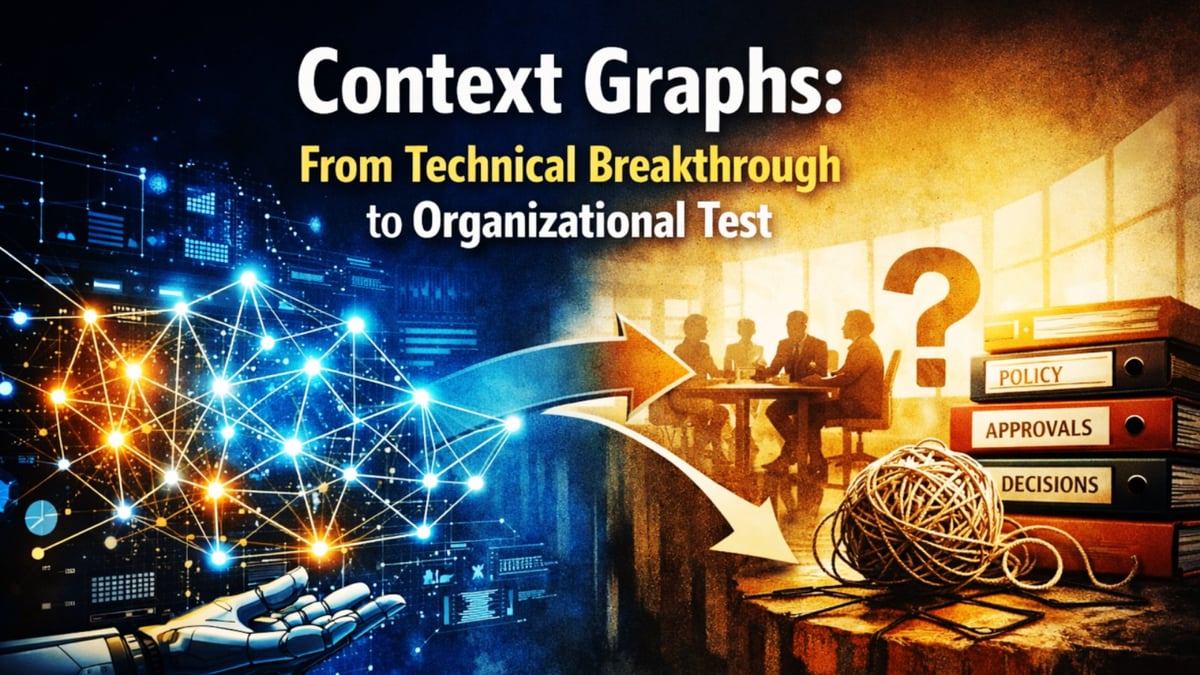
Much of the recent writing on context graphs, including thoughtful pieces by Jaya Gupta, Ashu Garg, Arvind Jain, Pete Soderling, and others, does an excellent job advancing the concept and highlighting what today’s AI architectures are missing. That direction resonates. What follows is not a technology pitch or investment narrative. It is an operator’s perspective, shaped by years inside enterprises that have lived through rule engines, expert systems, workflow automation, and early AI platforms that promised to encode judgment and scale decision-making. In many cases, the technology worked. The friction showed up in adoption, governance, incentives, and behavior.
From an operator’s seat, though, the right lens is less about novelty and more about pattern recognition. Enterprises have been here before. We have lived through rule engines, expert systems, workflow automation, and early AI platforms that promised to encode judgment and scale decision-making. In many cases, the technology worked. The friction showed up elsewhere: adoption, governance, incentives, and behavior.
Context graphs are surfacing now because they put a clear name to a problem many enterprise teams already feel. We are good at recording what happened. We are far less disciplined about recording the judgment behind it.
As AI systems begin to act inside real workflows, this gap stops being a technical inconvenience and becomes a material business risk. From an enterprise leader’s perspective, the idea makes sense. The real question is whether it holds up in practice.
Why Leaders Are Paying Attention
Once AI starts making or influencing decisions, leadership gets asked questions the organization cannot easily answer:
- Why was this exception approved?
- What precedent did the system follow?
Most enterprise systems can tell you the final outcome. Very few can explain the reasoning behind it. Today, people bridge that gap with experience, memory, and informal context. AI systems cannot do that on their own.
This is the gap context graphs are trying to address. They aim to preserve decision history so teams can review, audit, and learn from it over time. That is a real and meaningful benefit.
Where Things Get Complicated
In real organizations, decisions are rarely clear or tidy.
They unfold across meetings, escalations, inboxes, and informal exchanges that never cleanly land in a system. There is rarely a single moment when a decision is made and documented.
Because of this, any approach that relies on people explicitly recording decisions risks capturing only the official version, not the real one. That creates a different kind of risk. A clean record that sanitizes reality can be more dangerous than having no record at all.
Decision Memory Has Upsides and Risks
Context graphs remember all decisions, not just the good ones.
On the upside, this creates visibility. Leaders can identify patterns, understand how exceptions occur, and introduce accountability where it has been missing.
On the downside, decision memory can also harden behavior. If an organization routinely bends rules under pressure, those choices become precedent. Over time, what started as an exception quietly becomes standard practice.
Decision memory helps only when it is paired with clear intent and active oversight.
Not All Decisions Should Matter Equally
Another challenge is weighting. In practice, leaders quickly face questions like:
- Should a senior leader’s override carry more weight than policy?
- Should recent decisions matter more than older ones?
- When should an exception stop being relevant?
If a system treats all past decisions the same, it becomes noisy and confusing. Trust erodes. AI systems learn the wrong lessons. Context graphs require judgment embedded in how they are used, not just in how they store data.
People Will Adjust Their Behavior
When people know decisions are being recorded, behavior changes. This is not new.
We have seen it in performance metrics, compliance programs, and service-level agreements. Documentation gets cleaner. Sometimes too clean. Real discussions move elsewhere.
This does not make context graphs a bad idea. It makes them a leadership challenge. Incentives and culture matter as much as the technology itself.
Governance Is Central
Context graphs introduce governance questions that cannot be avoided:
- Who is allowed to record decisions?
- Who can correct or invalidate past decisions?
- How are disagreements resolved across teams?
If these questions go unanswered, adoption slows and teams work around the system. When addressed deliberately, context graphs can support better decision-making rather than add friction.
There Will Not Be One Source of Truth
It is also unrealistic to expect context graphs to become a single system of judgment.
Enterprises make decisions across many functions. Finance, Legal, Product, Support, and Sales all play a role. That reality will not change.
Context graphs can help connect those decisions, but they will always be incomplete and evolving. That is acceptable if expectations are set correctly.
What Success Looks Like
From an operator’s perspective, success does not mean capturing everything. It means:
- Starting with the most important and risky decisions
- Capturing just enough context to be useful
- Linking decisions to outcomes
- Making it easy for people to participate
Leaders do not need perfect memory. They need history they can act on.
Bottom Line
Context graphs are not a silver bullet. They are also not hype.
They address a real gap that becomes more pronounced as AI systems take on greater responsibility. They also show how decisions are actually made within organizations.
Whether they succeed depends less on technology and more on leadership choices. Scope, governance, incentives, and honesty will matter more than architecture.
From my perspective as an enterprise operator, context graphs are best viewed as a way to strengthen organizational memory, not as a replacement for human judgment. Their value will depend on whether teams are willing to learn from what that memory reveals and act on it.