

John Sabino at the CSS Executive Forum London: A Blueprint for Responsible, Customer-First AI
# CSS Executive Forums
AI-Infused Customer Journeys from Conversations to Outcomes
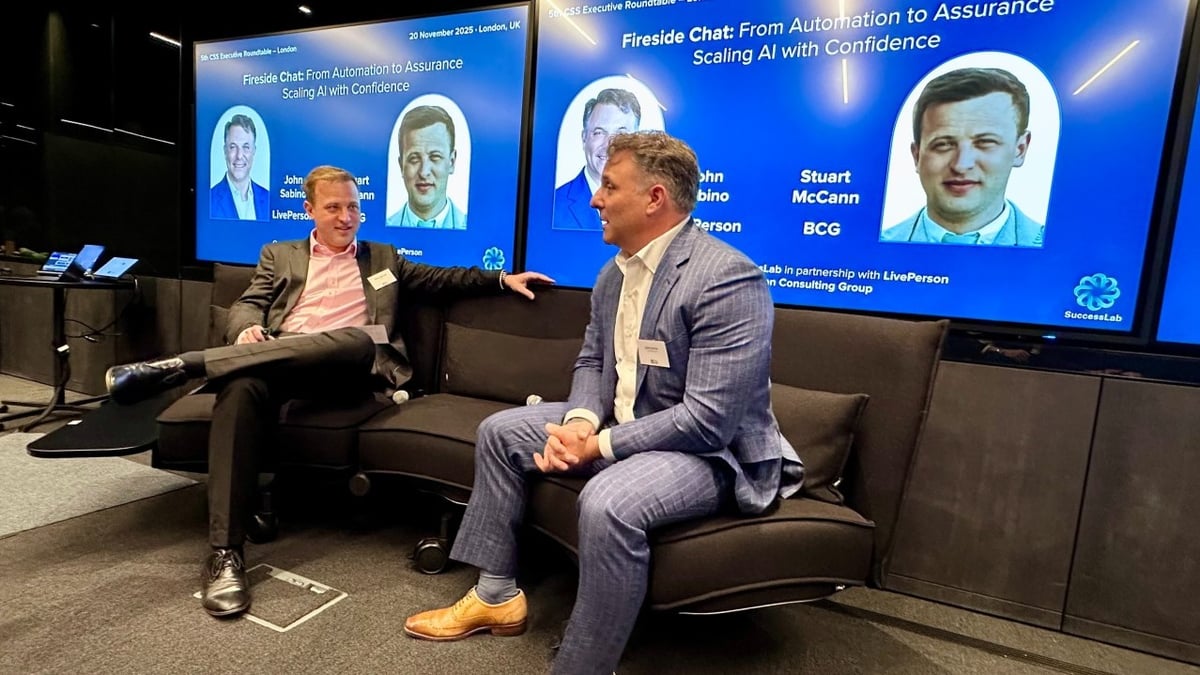
November 24, 2025At our CSS Executive Forum in London, we had one of the most grounded conversations on AI this year. John Sabino, CEO of LivePerson, joined Stuart McCann of BCG for a fireside chat that moved beyond the usual “AI will automate everything” and “AI will replace everyone” narratives. John spoke with the clarity of someone who has run large customer-facing organizations and understands exactly where AI helps, where it hurts, and where leaders need to proceed with intention.
John’s perspective has always been rooted in customer centricity. His years as a Chief Operating Officer and Chief Customer Officer at GE Digital, Splunk, and VMware taught him that trust, safety, and experience matter far more than any single AI feature. That lens shaped the entire discussion in London and resonated strongly with our community of Customer Experience, Customer Service, and Support leaders.

AI in the Boardroom: The Shift Everyone Feels but Few Have Articulated
John described how the boardroom conversation around AI has changed over the past three years.
Phase One: “Deploy AI and take out cost.”
Phase Two: “AI can make decisions like a human. Take out even more cost.”
Phase Three: “Just because we can automate something does not mean we should.”
Boards have learned through pilots, missteps, and customer feedback that the real challenge is not automation. The real challenge is assurance. Leaders need to understand how AI behaves, where it can fail, how to teach or correct it, and what each failure means for the brand.
John summarized the shift succinctly:
The question is no longer, “Can the model respond?”
The question is now, “Can we trust it, can we govern it, and can we correct it quickly?”

The Closed Governance Loop: See, Shape, Trust
A central theme in John’s remarks was the need for a closed governance and intelligence loop. He described this as the real breakthrough of modern AI. It is not the human-like responses or impressive demos. It is the ability for enterprises to:
• See how AI and humans behave across journeys
• Shape that behavior with better data, decisions, and interventions
• Trust the end-to-end experience through continuous monitoring and improvement
This is where governance, compliance, and guardrails become essential. Historically, compliance was a review step at the end of a project. In AI, that approach is inadequate. Compliance must sit inside the system, observing the interaction between humans, bots, and the orchestration layer beneath them.
John compared it to car brakes. Compliance isn't what's slowing you down. It is what allows you to move fast with confidence.
Simulation: The Layer Most AI Programs Still Miss
If there was a single point John emphasized again and again, it was simulation.
“You cannot deploy AI responsibly without simulation.”
He outlined three simulation layers that every enterprise needs.
1. Simulation for AI Agents
Organizations must be able to test bots against thousands of realistic customer scenarios and edge cases. This surfaces drift, guardrail failures, and logic gaps before customers experience them. Without simulation, the “blast radius” of errors becomes unacceptable.
2. Simulation for Human Agents
Humans also drift. They forget policy changes, misinterpret new pricing, and misunderstand how copilots should be used. John highlighted the importance of simulation embedded in the workflow, using synthetic conversations that measure accuracy and consistency in real time.
3. Simulation for the Orchestration Layer
This is the most difficult layer and the one that most vendors ignore. Real customer journeys involve:
- bots
- humans
- copilots
- routing
- workflows
- knowledge
- channels
- compliance checks
- back-end systems
These components must be tested together because this is how customers experience them. John stressed that the orchestration layer determines the true quality of the customer experience.
Why Compliance and Governance Are Now Central
When an audience member asked whether compliance slows everything down, John responded immediately:
“Compliance is not a handbrake. It is what keeps you from crashing.”
In industries such as financial services, healthcare, travel, and telecom, AI must be explainable, traceable, and correctable. When AI interacts with thousands of customers per hour, leaders need to know:
• where a decision was made
• why it was made
• whether it stayed within tolerance
• how to correct it at speed
Most compliance programs today are static. Annual audits, spot checks, and manual reviews do not work for AI. John argued that enterprises need continuous governance. They need systems that surface issues as they arise and that can respond immediately.

The Human and AI Tango
John rejected the idea that leaders must choose between full automation and full human support. He described the future as a coordinated tango between humans and AI.
AI should handle high-volume, low-value interactions.
Humans should focus on complex, emotional, or sensitive cases.
Copilots should amplify human capability.
He also outlined the new roles that will become essential in modern support organizations, including AI architects, conversation designers, and knowledge strategists.
One line stayed with many attendees:
“This is not about eliminating humans. It is about eliminating the wrong work.”
Why One Bot Will Never Be Enough
John was clear that the “one bot to rule them all” narrative is unrealistic. Enterprises will always require multiple models, multiple orchestration layers, and the flexibility to replace components as better technology emerges.
No single model will cover every interaction.
No enterprise will rely on a single LLM.
No vendor can deliver an all-in-one AI stack that remains best-in-class for long.
This is precisely why LivePerson invests in an open orchestration layer that supports multiple LLMs, deep simulation, and enterprise-grade governance.
A Better Way to Measure AI Success
John challenged the common practice of starting AI programs with efficiency targets. He argued for a more strategic order:
1. Customer Experience
Is the AI safe, on brand, clear, and capable of escalating to a human?
2. Revenue Impact
Does AI boost conversion, expansion, or product adoption?
3. Efficiency
Only after experience and growth are aligned should organizations optimize cost-to-serve.
This approach reframes AI as a growth and trust engine, not just an automation tool.
What Leaders Should Take Away
John’s fireside chat provided a clear playbook for leaders building AI-powered customer organizations:
- Start with the customer experience, not automation.
- Treat governance and guardrails as part of the operating model.
- Make simulation a foundational capability.
- Expect to manage multiple models and vendors.
- Prioritize trust, consistency, and revenue before efficiency.
- Build a human+AI system that strengthens your brand.
He reminded us that AI now touches customer experience on an unprecedented scale. Our responsibility is to manage that scale with rigor and intention.

Final Reflection
What stood out most from John Sabino’s conversation in London was not the technology itself. It was the mindset behind it. John spoke as someone who has lived through real customer escalations, operational challenges, AI drift, and compliance scrutiny. His message was simple and powerful:
“You are not deploying a bot. You are deploying your brand at scale. Treat AI with that level of respect.”
For leaders shaping the future of customer service, that mindset will matter more than any individual model or feature.
About SuccessLab
If you’d like to continue this dialogue, you’re warmly invited to:
- Subscribe to CCO Perspectives, my newsletter on how AI and leadership are reshaping customer service, support, and success
- Join our community at: community.successlab.us
I look forward to learning how you and your teams are shaping the next chapter of customer leadership.
Important Note
This article reflects my personal insights and reflections on John Sabino’s remarks at the CSS Executive Forum in London. It should not be interpreted as an endorsement or official position of LivePerson or its leadership.
Comments (0)
Popular

Dive in
Related
Blog
CSS Executive Forum Raleigh (RTP): Where Customer Leaders Are Building the AI-Enabled Future
Oct 20th, 2025 • Views 2
Blog
CSS Executive Forum Raleigh (RTP): Where Customer Leaders Are Building the AI-Enabled Future
Oct 20th, 2025 • Views 2