

Architecting the AI-Enabled Operating Model
# Executive Forum
How AI is reshaping workflows, accountability, and the future of the enterprise
March 31, 2026Most leadership teams are past the question of whether AI matters. The issue now is whether they can operationalize it in ways that are useful, governable, and scalable across the enterprise.
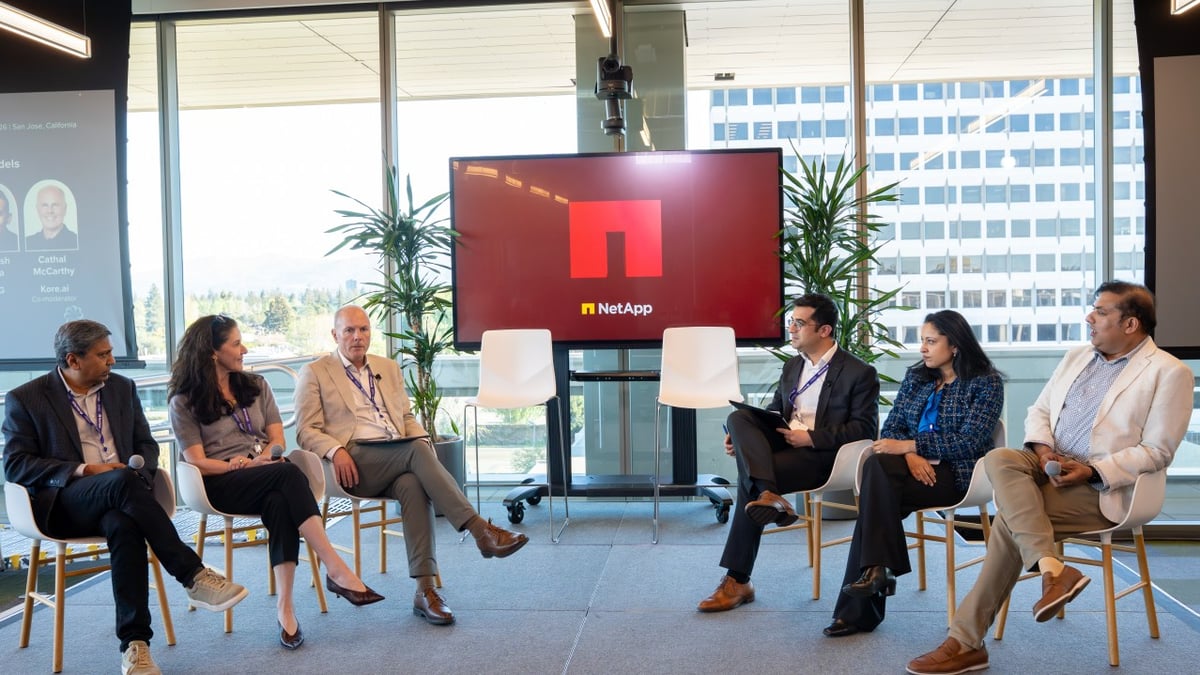
That was the focus of the panel discussion at our 7th SuccessLab Executive Forum in Silicon Valley, where senior leaders from UKG, Palo Alto Networks, Infor, HPE, Kore.ai, and BCG compared notes on what it takes as AI moves into the operating core of the business.
The discussion was grounded, practical, and operator-led. It centered on the choices leadership teams now face across data, workflow design, accountability, trust, talent, and cross-functional coordination.
The next phase of AI is not about pilots. It is about operating model redesign.
From Experimentation to Enterprise Execution
Across the discussion, AI was already shaping productivity, service delivery, product strategy, customer engagement, and enterprise priorities. The real issue was not relevance. It was whether organizations were prepared to redesign work, decision flows, and accountability around it.
As Angad Grewal of BCG observed, “The ambition around AI is high, but for many companies, reality is lagging ambition. The challenge is turning pilots into scaled, realizable business value.”
That gap between ambition and execution sat at the center of the conversation.
Pilots do not change an enterprise. Execution does.
Foundation Still Determines Scale
Another important theme was this: AI raises the cost of weak foundations.
Mari Cross put it directly: “You cannot build meaningful AI outcomes on a weak foundation. Data, content, and process discipline still matter.”
That issue surfaced throughout the discussion. For many organizations, the constraint is not the promise of AI. It is the fragmentation already in the system: scattered data, inconsistent processes, weak content structures, and multiple versions of the truth across functions.
Prakash Kota made the point plainly: “If everyone is looking at different data, scale becomes impossible. Even an imperfect shared truth is better than fragmented insight.”
He also underscored something leadership teams should take more seriously: “Invest in AI literacy, not just AI tools. Buying technology is easy. Changing how people work and make decisions is the harder and more important job.”
Scaling AI is not just a technology effort. It depends on the quality of the foundation, the consistency of decisions, and the organization’s ability to work in new ways.
My takeaway: AI magnifies what is already broken.

Workflow Redesign Drives Value
Another recurring theme was the need to redesign workflows from the outcome back.
Too often, organizations are layering AI onto processes built around manual handoffs, legacy systems, and long-standing constraints. That may improve efficiency at the margins, but it leaves the larger opportunity untouched.
Prakash Kota framed it well: “The biggest mistake companies can make is applying AI to yesterday’s workflows. Start with the outcome, then redesign the process around what AI makes possible.”
That is the shift. AI stops being a tool discussion and becomes an operating model discussion.
Swetal Desai offered a practical example from HPE’s support operations. A technical support case that once moved through multiple manual steps can now be coordinated across diagnosis, parts, scheduling, field service, and follow-up. Once that becomes possible, the question changes.
As he put it: “Once you automate a reactive customer support workflow, the next question is bigger: why are we waiting for the customer to raise the issue in the first place?”
The larger opportunity is not to accelerate the old model. It is to redesign the work around earlier intervention, tighter coordination, and more proactive outcomes.
My takeaway: do not automate the wrong workflow.
Context Makes AI Useful
Lavina Pinto introduced a useful framing with what she called a “two-brain” model.
One brain holds enterprise and customer context: what was sold, what value was promised, what constraints the customer faces, and which outcomes matter most. The other holds product intelligence: how the product works, how it is deployed, and how it should perform.
She put it simply: “The customer cares whether it delivers the business value that was promised.”
She added, “AI becomes powerful when you connect two kinds of intelligence: the product brain and the customer context brain.”
That framing reaches well beyond support. It affects how sales transitions into onboarding, how deployments are guided, how adoption is monitored, how issues are interpreted, and how renewal conversations are informed.
Prakash Kota described a related effort at UKG through a customer experience initiative that brings signals together from multiple sources to guide action. The value is not in surfacing more signals. It is in helping teams decide where to focus and what to do next.
AI becomes more useful when it improves prioritization, judgment, and precision.
My takeaway: Without context, AI is guesswork.
Human Judgment Still Matters
The discussion treated human involvement as a design choice, not a default position.
Prakash Kota offered a practical guide: “High-stakes, irreversible decisions still need human judgment. Low-stakes, reversible work is where autonomy can create real leverage.”
Lavina Pinto added an important nuance: “It is not either human or AI. It is an intentional blend of deterministic controls, probabilistic reasoning, and clear decision rights.”
That distinction matters. Some decisions require judgment, accountability, and precision. Others are better suited to speed, pattern recognition, and scale. Leadership’s role is to define those boundaries deliberately.
Mari Cross brought in an equally important dimension from the customer side: “One of the biggest challenges we are not talking about enough is helping customers adopt these changes. The technology may be exciting, but for many people it is also unsettling.”
Trust is not established by system design alone. It depends on whether people, inside and outside the enterprise, are willing to rely on the outcome.
My takeaway: trust still depends on human judgment.
Leaders Still Own the Outcome
One principle held throughout the discussion: AI may change how work is executed, but it does not change who owns the result.
AI can recommend, summarize, prioritize, and orchestrate. Accountability still rests with the business leader.
Swetal Desai put it directly: “The process owner remains accountable for process outcomes, whether the work is done by humans, AI agents, or both.”
As AI becomes part of the workforce, that responsibility does not move with it. If a process sits within your organization, so does the outcome.
Swetal also offered a useful discipline for where leaders should focus: “The goal is not to deploy AI everywhere. The goal is to focus where there is a real burning platform, usable data, meaningful scale, and an end-to-end process worth transforming.”
That is the right filter. Without it, AI effort gets spread across too many pilots, tools, and disconnected use cases. With it, leaders can concentrate attention where business value is most likely to follow.
My takeaway: AI does not change who owns the outcome.

The Workforce Challenge
The workforce implications were impossible to ignore. Workforce transformation is not peripheral to AI strategy. It sits at the center of it.
Prakash Kota emphasized the importance of AI literacy, peer learning, and broad participation in helping teams adapt. Lavina Pinto pointed to the role shifts already underway: “We need to rethink roles through an AI lens. Domain experts are becoming evaluators, context shapers, and architects of better outcomes.”
That is an important shift. Expertise is not disappearing. It is being redirected. The people with the deepest understanding of the business will increasingly shape how AI is guided, evaluated, and improved.
Swetal Desai added one of the more candid observations of the evening: “My biggest concern is the middle of the organization. That is where deep process knowledge sits, and where resistance to redesign can be strongest.”
That point deserves close attention. The middle of the organization often holds both the deepest operational knowledge and the strongest attachment to existing ways of working. It is also where redesign can slow.
My takeaway: AI adoption will be won or lost in the middle.
Customer Operations Driving Growth
The discussion also pointed to a broader shift in the role of customer-facing teams.
Customer service, support, and success have traditionally been measured on efficiency and responsiveness. Those measures still matter. What is changing is their ability to contribute more directly to retention, expansion, and strategic value.
Mari Cross described that shift well: “As AI helps us personalize at scale, customer organizations have a real opportunity to influence both retention and growth more directly.”
Swetal Desai made a related point from the operations side: “As AI takes away more transactional work, customer operations can move closer to revenue, retention, and strategic insight.”
As routine work recedes, customer organizations have more room to generate intelligence, shape action, and contribute more directly to growth.
My takeaway: customer operations is becoming a growth driver.
The Leadership Agenda
The panel reinforced a broader point: AI is no longer an innovation effort at the edge. It now sits on the core leadership agenda.
Its implications extend well beyond technology. They reach into operating model design, decision rights, governance, customer trust, role redesign, change management, and cross-functional alignment. They require leadership judgment on where to focus, what to redesign, how to define value, and how to move the organization with conviction.
Cathal McCarthy put it directly: “AI transformation is not just about the technology. It is about the trade-offs you make across automation, talent, structure, and operating discipline.”
He also framed the moment well: “We are past the point of asking whether AI matters. The real question is whether organizations are ready to redesign how work gets done.”
Angad Grewal extended the point: “This is no longer a conversation solely about the technology, models, and algorithms. It is a conversation about reimagining the operating model and the programmatic change orchestration required to truly unlock value at scale.”
That is where the discussion has moved. It is also why these peer forums matter. They give leaders space to compare notes, challenge assumptions, and think more deliberately about the model they are building.
AI may enter through technology, but it belongs on the leadership agenda.
Our thanks again to Mari Cross, Lavina Pinto, Prakash Kota, and Swetal Desai for bringing depth, candor, and real operating perspective to the panel, and equally grateful to Angad Grewal and Cathal McCarthy for moderating with thoughtfulness and discipline, and for guiding a strong Q&A that extended the conversation in useful and substantive ways.
To join the conversation and follow future SuccessLab forums, roundtables, and workshops, visit SuccessLab.us and subscribe to the CCO Perspectives newsletter for updates.
Comments (0)
Popular

Dive in
Related
Blog
Stop Shipping Friction: Make AI-Enabled Onboarding Your #1 AI Investment
Jul 25th, 2025 • Views 5
Blog
CSS Executive Forum Raleigh (RTP): Where Customer Leaders Are Building the AI-Enabled Future
Oct 20th, 2025 • Views 2
Blog
CSS Executive Forum Raleigh (RTP): Where Customer Leaders Are Building the AI-Enabled Future
By Omid Razavi • Oct 20th, 2025 • Views 8
Blog
Stop Shipping Friction: Make AI-Enabled Onboarding Your #1 AI Investment
Jul 25th, 2025 • Views 5
Blog
CSS Executive Forum Raleigh (RTP): Where Customer Leaders Are Building the AI-Enabled Future
Oct 20th, 2025 • Views 2
Blog
CSS Executive Forum Raleigh (RTP): Where Customer Leaders Are Building the AI-Enabled Future
By Omid Razavi • Oct 20th, 2025 • Views 8